Think Like a Monk: Key Insights & Takeaways from Jay Shetty
Discover how ancient monk wisdom transforms modern stress into lasting peace—practical tools for purpose, focus, and inner fulfillment.
by The Loxie Learning Team
Jay Shetty spent three years living as a monk in an ashram, and Think Like a Monk distills that ancient wisdom into practical tools for navigating modern life. The book's core message is surprisingly accessible: you don't need to renounce the world to find peace—you need to change how you relate to your thoughts, relationships, and purpose.
This guide unpacks Shetty's most transformative insights. You'll learn how to identify whose voices really live in your head, master the three-step technique for breaking negative thought patterns, and discover why your natural talents often hide your greatest purpose. Whether you're battling anxiety, searching for meaning, or simply exhausted by mental noise, these monk-tested practices offer a path forward.
 Start practicing Think Like a Monk ▸
What are the three core practices of monk wisdom?
Monk wisdom rests on three foundational practices: detachment from external validation, awareness of your mental patterns, and service to others. These aren't abstract spiritual concepts—they're practical tools for transforming everyday struggles into opportunities for growth. Shetty argues that peace doesn't come from escaping reality but from systematically training your mind to respond differently to life's challenges.
The genius of this framework lies in how these practices reinforce each other. When you stop seeking validation from others, you gain the mental space to observe your own thought patterns. When you understand those patterns, you can redirect that energy toward serving others. And when you serve others, you naturally release the grip of ego-driven validation-seeking. It's a virtuous cycle that monks have refined over centuries.
For Christians, this framework echoes biblical wisdom about the spiritual life. The call to detachment mirrors Paul's instruction to "set your minds on things above, not on earthly things" (Colossians 3:2). The emphasis on mental awareness aligns with the biblical mandate to "take every thought captive" (2 Corinthians 10:5). And the practice of service reflects Christ's teaching that the greatest among us must be servants of all. While Shetty draws from Vedic tradition, these principles resonate with ancient Christian practices of humility, self-examination, and love of neighbor.
How do you discover your authentic self through value shedding?
Your authentic self emerges when you audit whose voices actually live in your head—parents, friends, social media, cultural expectations—and consciously choose which influences to keep versus release. Shetty calls this practice "value shedding," and it begins with a uncomfortable truth: most of us have never questioned whether our deepest ambitions are truly our own or borrowed from others.
The process works by systematically examining each belief you hold and asking: "Did I arrive at this through my own reflection, or did I absorb it unconsciously from my environment?" This isn't about rejecting all external influence—that would be impossible. It's about moving from unconscious programming to conscious choice. When you adopt a value deliberately after examination, it becomes genuinely yours even if you originally encountered it elsewhere.
The Why Ladder technique
Shetty introduces the "Why Ladder"—asking "why" five times about any desire you hold. If you want to make more money, you ask why. Perhaps for security. Why do you want security? Because you fear being dependent on others. Why does that frighten you? And so on. By the fifth level, you often discover that surface-level wants like wealth or status mask deeper needs for security, love, or meaning. This reveals whether you're pursuing borrowed dreams or authentic aspirations.
Loxie helps you internalize this questioning practice so it becomes second nature. Instead of reading about the Why Ladder once and forgetting it, you'll practice applying it to your actual desires through spaced repetition, building the habit of self-examination that genuine growth requires.
Practice value shedding with Loxie ▸
What is the Spot-Stop-Swap technique for negativity?
The Spot-Stop-Swap technique is a three-step intervention that transforms negative thoughts before they hijack your emotions and actions. First, you Spot the negative thought as it arises—simply noticing "I'm thinking something negative right now." Second, you Stop by pausing before the thought triggers its usual cascade of reactions. Third, you Swap the negative thought for a constructive alternative.
The power of this technique lies in breaking the automatic cycle where negative thoughts instantly produce negative emotions and behaviors. Most people experience this sequence so rapidly that it feels like one event: something happens, and they react. But monks recognize multiple decision points between stimulus and response. The Spot-Stop-Swap method teaches you to insert conscious choice into what previously felt like involuntary reaction.
Consider a practical example: someone criticizes your work. The untrained mind immediately spirals—defensive thoughts, hurt feelings, perhaps angry words. With Spot-Stop-Swap, you notice the defensive thought arising (Spot), pause before engaging with it (Stop), and replace it with something more useful: "This feedback might help me improve" or "This person's opinion doesn't determine my worth" (Swap). Over time, this conscious intervention rewires the automatic patterns themselves.
This practice requires repetition to become instinctive. Reading about it once won't change ingrained mental habits. Loxie's spaced repetition system helps you encounter Spot-Stop-Swap repeatedly at optimal intervals, so the technique is ready when you actually need it—not buried in a book you read months ago.
How does fear become a teacher through fear inquiry?
Fear becomes your teacher when you practice what Shetty calls "fear inquiry"—systematically questioning each fear to extract its wisdom. The process involves three questions: What specific loss am I afraid of? Is that loss real or imagined? What growth opportunity hides behind this fear? Most fears protect against imaginary futures that never materialize, and by examining them directly, you transform paralysis into insight.
Shetty distinguishes four categories of fear, each requiring different courage strategies. Fear of losing what you have responds to acceptance practices. Fear of not getting what you want responds to detachment. Fear of being judged responds to authenticity. Fear of repeating past pain responds to learning and reframing. By categorizing your fears rather than treating them as one overwhelming force, you can apply targeted responses rather than generic "feel the fear and do it anyway" advice.
Courage as values-aligned action
The monk perspective reframes courage from a feeling to a choice. Courage isn't waiting until fear disappears—it's acting in alignment with your values despite fear's presence. This shift is liberating because it makes fear irrelevant to decision-making. You don't need to feel brave; you simply need to choose what matters more than your comfort. This echoes the biblical pattern where heroes of faith acted not in the absence of fear but in the presence of God's call.
Fear inquiry sounds simple—but will you remember it when anxiety strikes?
Intellectual knowledge of these techniques evaporates under stress. Loxie uses active recall to help you practice fear inquiry until it becomes instinctive, available precisely when your mind needs it most.
Build fear inquiry into your mental toolkit ▸Why should intentions be set at three levels?
Intentions set at three levels—personal growth, relationship enrichment, and service to others—create sustainable motivation because they align selfish and selfless drives rather than forcing you to choose between them. The Vedic framework recognizes a truth that purely self-help approaches miss: goals focused only on personal gain eventually burn out, while goals focused only on others feel unsustainable. But intentions that benefit you, your loved ones, and the wider world create a reinforcing cycle.
When your personal growth makes you a better partner, and being a better partner increases your capacity to serve your community, and serving your community deepens your character—you've created an upward spiral. Each level of intention feeds the others. This isn't spiritual mathematics; it's practical wisdom about human motivation. We need to feel that our growth matters beyond ourselves, but we also need tangible personal benefit to sustain effort.
Christians will recognize this pattern in the Great Commandments: love God (vertical intention), love neighbor (outward intention), as yourself (personal intention). The monk framework provides practical structure for living out this integrated vision where self-care enables service rather than competing with it.
What is dharma and how do you discover it?
Dharma emerges at the intersection of four elements: what you're naturally good at, what you love doing, what the world genuinely needs, and what can sustain you financially. While this resembles the Japanese concept of ikigai, the monk approach makes a crucial distinction: monks prioritize the first three elements over the fourth. Monetary reward is treated as a byproduct of excellence in serving genuine needs, not a primary driver of decision-making.
This ordering matters because chasing money first often leads you away from your dharma. The logic runs in the opposite direction: when you develop excellence in something you love that serves real needs, sustenance tends to follow. This isn't naive idealism—monks acknowledge the need for material provision—but a different causal sequence than "find what pays, learn to love it, and hope it serves others."
Hidden talents reveal dharma
Your dharma often hides in what you do effortlessly that others find difficult. The skills you dismiss as "nothing special" because they come easily frequently represent your greatest gifts to offer the world. We're blind to our own natural talents precisely because they feel effortless—we assume everyone can do what we do. Asking trusted friends "What do I do better than most people?" often reveals dharma clues invisible to self-reflection alone.
The quadrant test for purpose
Shetty introduces a practical diagnostic: map your activities by energy and time. What energizes you despite taking significant time? What drains you even though it's quick? Activities in the "energizing but time-consuming" quadrant often indicate dharma because they create flow states where effort feels effortless. The "draining but quick" quadrant reveals misalignment regardless of your competence. This simple framework can clarify career decisions that feel impossibly complex.
Discover your dharma with Loxie ▸
How does the monk schedule optimize daily energy?
The monk schedule aligns tasks with natural energy rhythms rather than forcing productivity against your biology. The framework divides the day into four blocks: 4-8am for learning and spiritual practice (the "brahma muhurta" or creative hour), 8am-12pm for focused work requiring deep concentration, 12-4pm for communication and collaborative tasks, and 4-8pm for relationships and rest.
This structure, refined over centuries in ashrams, matches cognitive demands to circadian rhythms. Early morning hours, when the mind is fresh from sleep, are ideal for absorbing new information and meditation. Late morning provides peak focus before digestive processes from lunch redirect blood flow. Afternoon, when individual concentration naturally dips, suits social interaction. Evening allows transition toward rest.
Most people fight their biology, attempting deep work during afternoon energy troughs or scheduling important meetings during peak focus hours. The monk schedule doesn't demand more discipline—it demands less by working with your natural rhythms rather than against them. Even adopting one principle—protecting morning hours for your most important mental work—can transform productivity.
What is the T.I.M.E. morning routine method?
The T.I.M.E. method structures morning routines through four sequential practices: Thankfulness (gratitude), Intention (daily purpose), Meditation (mental clarity), and Exercise (physical energy). This specific sequence deliberately activates different brain regions in optimal order, creating compound momentum that carries through the entire day.
Gratitude primes the brain for positivity before you encounter the day's stresses. Setting intention provides direction so you're not merely reactive. Meditation clears mental clutter accumulated during sleep and creates space between stimulus and response. Exercise energizes action and anchors the mental work in physical reality. Each practice prepares the ground for the next, creating multiplicative rather than additive benefits.
The key insight is that morning routines shouldn't be random collections of good habits but intentionally sequenced practices that build on each other. Someone who exercises first thing might feel physically energized but mentally scattered. Starting with gratitude and intention means your physical energy serves clear direction rather than dispersing in activity for its own sake.
What is the difference between monkey mind and monk mind?
The monkey mind jumps restlessly between thoughts like a monkey swinging between branches, constantly seeking stimulation and never at rest. The monk mind remains stable like a tree, rooted in awareness while thoughts come and go like passing weather. The crucial insight: meditation trains you to observe the monkey's jumping without joining it—to watch thoughts arise and pass without being swept away by their momentum.
This metaphor revolutionizes what most people think meditation accomplishes. The goal isn't to stop thinking—that's impossible and actually counterproductive. The goal is to change your relationship to thinking. Instead of being your thoughts, you become the awareness that observes thoughts. From this stable vantage point, individual thoughts lose their power to hijack your attention and emotions.
The noting technique
Shetty teaches the "noting" meditation technique where you mentally label thoughts as "thinking," emotions as "feeling," and physical sensations as "sensing" as they arise. This simple act of naming creates distance between you and the mental content. You shift from being consumed by thoughts to witnessing them, discovering the stable awareness that remains unchanged regardless of what passes through it. Regular practice reveals that you are not your thoughts—you are the one who notices them.
Master monk mind practices with Loxie ▸
How does ego create suffering according to monk wisdom?
Ego creates suffering through two fundamental lies: "I am separate from others" (breeding competition and isolation) and "I am my achievements" (making self-worth conditional on performance). The monk understanding sees ego not as healthy confidence but as insecurity masquerading as strength. True power comes from knowing you have nothing to prove because your value isn't earned but inherent.
The separation lie generates endless comparison. If I'm fundamentally distinct from you, then your success becomes my failure by implication. Life becomes zero-sum. But monks recognize interconnection as reality—your flourishing doesn't diminish mine. This isn't sentimentality; it's clear seeing that dissolves the competitive anxiety driving so much modern misery.
The achievement lie creates a treadmill where no accomplishment brings lasting satisfaction because there's always another milestone required to maintain self-worth. You become your resume, and any failure feels like existential threat. Monks break this pattern by grounding identity in being rather than doing—recognizing intrinsic worth that achievements can express but never create.
For Christians, this teaching resonates with biblical anthropology: we are image-bearers whose worth comes from God's creative love, not our productivity. The ego's lies are ultimately lies about the source of human dignity. Humility—seeing ourselves rightly in relation to God and others—heals what ego distorts.
How does gratitude physically rewire your brain?
Gratitude physically rewires your brain through what neuroscientists call "experience-dependent neuroplasticity." The key practice: when you notice a positive experience, consciously savor it for at least 20 seconds. This extended attention helps the experience transfer from short-term to long-term memory, literally changing your neural architecture toward a more optimistic baseline.
The brain naturally focuses on threats for survival reasons—a negativity bias that kept our ancestors alive but leaves modern humans anxious about dangers that rarely materialize. The 20-second rule counteracts this bias. By deliberately prolonging positive experiences, you build neural pathways for noticing and remembering good things. Over time, this shifts your default mental state from threat-scanning to appreciation.
The gratitude ladder
Shetty describes a progression in gratitude practice: from appreciating things (possessions, circumstances), to appreciating people (relationships, acts of kindness), to the highest level—appreciating challenges that forced growth you wouldn't have chosen. This final stage transforms suffering's meaning. Instead of asking "Why did this happen to me?" you ask "What is this making possible?" Few practices rival this for converting victimhood into empowerment.
Scripture models this progression: Paul writes of being "content in all circumstances" (Philippians 4:11-12) and of rejoicing in suffering because it produces character (Romans 5:3-4). The gratitude ladder provides practical steps toward this counter-intuitive biblical wisdom.
What are the four trust levels in relationships?
Relationships exist at four trust levels, and most people are stuck at the first two while missing deeper connection possibilities. Transactional relationships involve exchange—I help you, you help me. Emotional relationships provide support during difficulties. Intellectual relationships stimulate growth through challenging ideas. Spiritual relationships share purpose and meaning at the deepest level.
Understanding which level each relationship operates at prevents disappointment. Expecting spiritual depth from a transactional work relationship sets you up for frustration. Recognizing that a particular friend operates at the emotional level helps you appreciate what they offer rather than resenting what they can't provide. Each level has value; the insight is matching expectations to reality.
This framework also reveals opportunities. Some relationships have potential for deeper levels that you've never consciously developed. The intellectual friend who you only discuss ideas with might be capable of spiritual connection if you invited it. The 75% rule for relationships—taking three-quarters responsibility for connection quality rather than waiting for others to improve—helps you consciously deepen bonds that have greater potential.
How does service follow the circle of concern model?
Service follows expanding circles: starting with yourself (necessary, not selfish), expanding to family, then community, then strangers—with each ring strengthening your capacity for the next. Like the airline oxygen mask principle, you can't sustainably serve from depletion. Monks build outward from a stable center rather than sacrificing themselves in misguided martyrdom.
This ordering challenges both selfish and selfless extremes. Pure self-focus ignores our interconnection and the joy that service brings. Pure others-focus leads to burnout, resentment, and actually less capacity to help. The monk way integrates both: caring for yourself enables caring for others. Self-care becomes an act of love for those who depend on you.
Serving through strengths
Seva (selfless service) transforms from burden to joy when you serve through your strengths rather than obligations. A natural teacher creates more impact tutoring than reluctantly fundraising. Monks match service to skills because forced service breeds resentment while aligned service feels effortless. This creates sustainable contribution that energizes rather than depletes. The question isn't just "What needs doing?" but "What needs doing that I'm uniquely equipped to offer?"
The highest form of service isn't doing for others but empowering others to do for themselves. Teaching someone to fish rather than giving fish transforms one life into a multiplier effect. True compassion increases others' agency rather than creating dependency on your continued giving.
How do specific breathing ratios create different outcomes?
Breathwork follows specific ratios for predictable outcomes: 4-4-4-4 (box breathing) for calm, 4-7-8 for sleep, and energizing breath (rapid bellows breathing) for alertness. These patterns trigger distinct nervous system responses within minutes, making breath a pharmacy you carry everywhere—pharmaceutical-level interventions without side effects or dependencies.
Box breathing (4 counts inhale, 4 counts hold, 4 counts exhale, 4 counts hold) activates the parasympathetic nervous system, reducing cortisol and heart rate. Navy SEALs use this technique in high-stress situations. The 4-7-8 pattern (4 counts inhale, 7 counts hold, 8 counts exhale) extends the exhale, which signals deep safety to your nervous system and induces sleep within minutes. Energizing breath (rapid inhales and exhales like bellows) increases oxygen and alertness when you're drowsy.
The monk insight is that these aren't tricks but direct nervous system interventions. Your breath is one of the few autonomic processes you can consciously control, and through it, you can shift your entire physiological state. Knowing the right ratio for your current need gives you real-time tools for anxiety, insomnia, or fatigue that require nothing external.
Master breathwork ratios with Loxie ▸
The real challenge with Think Like a Monk
The irony of Think Like a Monk is that reading it once might make you feel peaceful for a few days—but within weeks, most of these insights will fade from memory. The Spot-Stop-Swap technique won't come to mind when you actually need it. The breathing ratios will blur together. The T.I.M.E. method will become a vague memory of "something about morning routines."
This isn't a failure of the book—it's how human memory works. Psychologist Hermann Ebbinghaus discovered that we forget roughly 70% of new information within 24 hours and up to 90% within a week without active reinforcement. Shetty can give you the map, but your brain will lose the coordinates unless you actively practice recall.
How many self-help books have you read that genuinely changed your daily behavior? Not just inspired you temporarily, but actually rewired your responses? The gap between inspiration and transformation is the gap between passive reading and active retention. Monks don't read wisdom once—they practice it daily until it becomes reflex.
How Loxie helps you actually remember what you learn
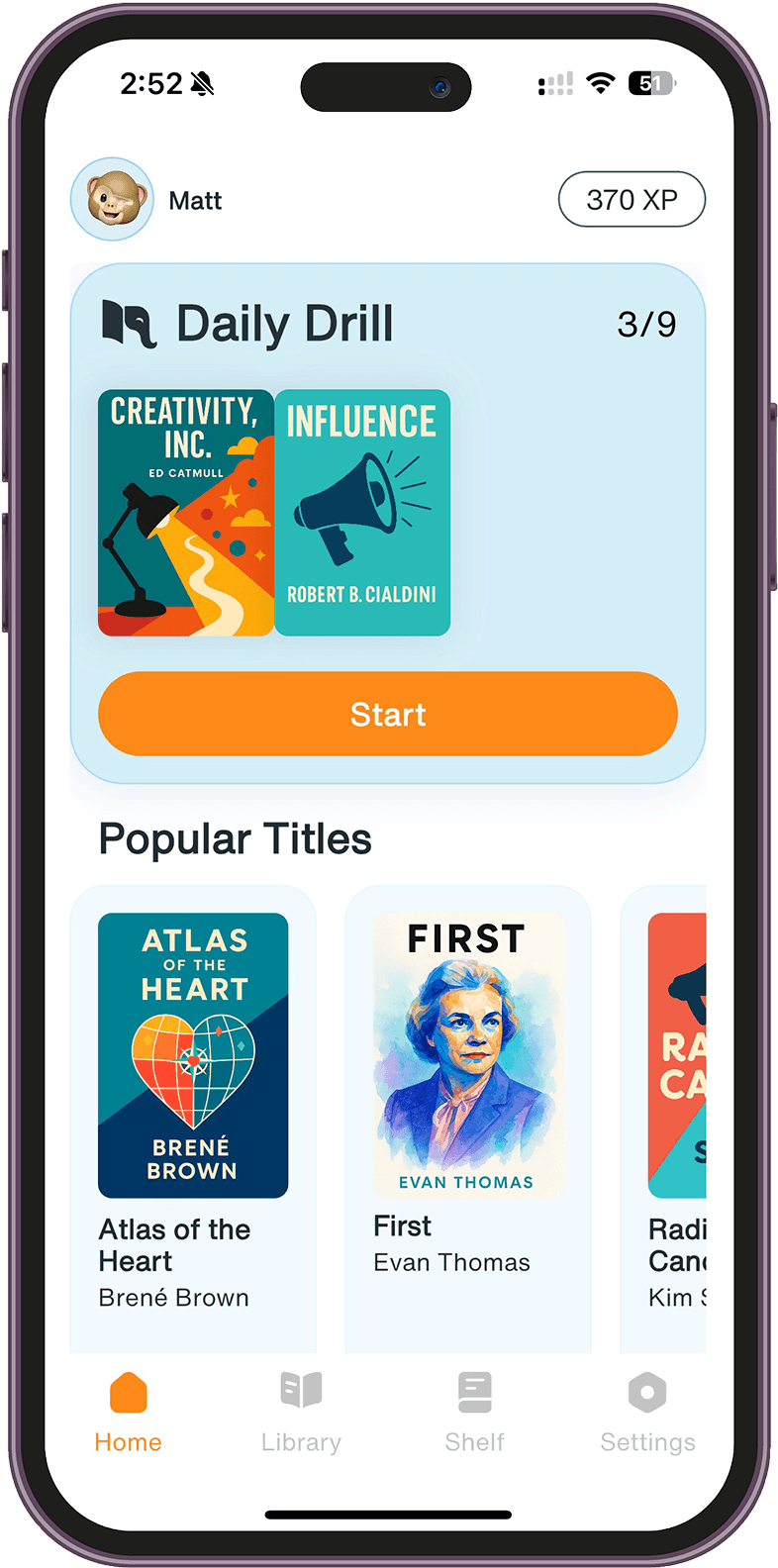
Loxie uses spaced repetition and active recall—the same learning science that monks have practiced for millennia—to help you internalize Think Like a Monk's wisdom. Instead of reading once and hoping insights stick, you practice for just 2 minutes a day with questions that resurface key concepts right before you'd naturally forget them.
The difference is transformational. When stress hits and you need Spot-Stop-Swap, it's there—not buried in a book on your shelf but embedded in your mental toolkit. When you're deciding how to spend your morning, the T.I.M.E. framework is accessible, not a fading memory. Loxie turns inspiration into installation.
Loxie includes Think Like a Monk in its full topic library. You can start reinforcing these concepts immediately, building the monk mindset that Shetty describes into genuine daily practice. Because wisdom that you can't remember when you need it isn't really wisdom—it's just information that passed through.
Frequently Asked Questions
What is the main message of Think Like a Monk?
Think Like a Monk teaches that peace and purpose come not from escaping modern life but from applying three core monk practices: detachment from external validation, awareness of your mental patterns, and service to others. Shetty shows how these ancient principles transform everyday struggles into spiritual growth through practical techniques anyone can use.
What is the Spot-Stop-Swap technique?
Spot-Stop-Swap is a three-step method for breaking negative thought patterns. First, Spot the negative thought as it arises. Second, Stop by pausing before reacting. Third, Swap the negative thought for a constructive alternative. This breaks the automatic cycle where negative thoughts hijack emotions and behaviors.
What is dharma according to Jay Shetty?
Dharma is your purpose, found at the intersection of what you're good at, what you love, what the world needs, and what sustains you financially. Unlike ikigai, monks prioritize the first three over money, believing excellence in serving genuine needs naturally attracts sustenance as a byproduct.
What is the T.I.M.E. morning routine method?
T.I.M.E. stands for Thankfulness, Intention, Meditation, and Exercise—four practices done in sequence each morning. Gratitude primes positivity, intention provides direction, meditation clears mental clutter, and exercise energizes action. The specific order creates compound momentum for the entire day.
What breathing techniques does Think Like a Monk teach?
Shetty teaches specific breathing ratios: 4-4-4-4 (box breathing) for calm, 4-7-8 for sleep, and rapid bellows breathing for energy. These patterns trigger predictable nervous system responses within minutes, making breath a portable pharmacy for anxiety, insomnia, or fatigue.
How can Loxie help me internalize the truths from Think Like a Monk?
Loxie uses spaced repetition and active recall to help you retain Shetty's practical wisdom. Instead of reading once and forgetting, you practice for 2 minutes a day with questions that resurface techniques like Spot-Stop-Swap right before you'd naturally forget them. Loxie includes Think Like a Monk in its full topic library.
We're an Amazon Associate. If you buy a book through our links, we earn a small commission at no extra cost to you.
Stop forgetting what you learn.
Start learning for good with your 7-day FREE trial.