To Sell Is Human: Key Insights & Takeaways from Daniel Pink
Master Daniel Pink's framework for moving others in a world where we're all in sales—whether we realize it or not.
by The Loxie Learning Team
Think you're not in sales? Think again. Daniel Pink's To Sell Is Human reveals a startling truth: we spend roughly 40% of our work time persuading, influencing, and convincing others. Teachers sell students on the value of learning. Doctors sell patients on treatment plans. Parents sell children on eating vegetables. The ability to move others isn't a specialized profession anymore—it's a fundamental survival skill in the modern economy.
This guide breaks down Pink's complete framework for ethical, effective persuasion in an age where the old rules no longer apply. You'll learn the new ABCs of selling, six powerful alternatives to the elevator pitch, and why honesty has become your greatest competitive advantage. Whether you've read the book and want a refresher, or you're discovering these ideas for the first time, you'll walk away understanding how to move others without manipulation.
 Start practicing To Sell Is Human free for 7 days ▸
Why does Daniel Pink argue that everyone is in sales now?
Everyone is in sales now because the nature of work itself has fundamentally transformed, making the ability to move others essential across all professions—not just for those with "sales" in their job title. Pink's research found that while only 1 in 9 Americans officially work in sales, the other 8 spend 24 minutes of every hour at work engaged in what he calls "non-sales selling": persuading, influencing, and convincing others to exchange resources like attention, effort, or commitment.
This shift reflects several structural changes in the economy. The explosion of entrepreneurship means more people work in small businesses where functional specialization is impossible—when your company has five employees instead of five thousand, everyone must pitch clients, advocate for ideas, and move the organization forward. Job elasticity has stretched beyond formal descriptions: engineers must pitch projects to leadership, accountants must sell recommendations to clients, and designers must advocate for their creative vision to stakeholders.
Perhaps most significantly, the fastest-growing job sectors—education and healthcare—are fundamentally about moving others. Teachers move students to learn. Nurses move patients to take medications. These roles require human connection and persuasion skills that can't be automated, signaling that the future economy will be dominated by professionals who might never think of themselves as salespeople but whose success depends entirely on their ability to influence others.
What are the new ABCs of selling and why do they replace "Always Be Closing"?
The new ABCs of selling are Attunement, Buoyancy, and Clarity—three qualities that replace the old "Always Be Closing" mantra because information parity has fundamentally shifted power from sellers to buyers. In the old world, salespeople held exclusive knowledge about products, prices, and alternatives. Today, customers can access this information instantly through smartphones and search engines, making manipulation and information hoarding not just unethical but ineffective.
Attunement: The power of perspective-taking
Attunement is the ability to see from another's perspective and bring your actions into harmony with theirs. Counterintuitively, research shows that ambiverts—people who can shift between talking and listening—outperform both extreme extraverts and introverts in sales situations. The stereotype of the glad-handing, always-talking salesperson is actually a recipe for failure. The most effective sellers modulate their approach, knowing when to assert and when to assess, when to speak and when to listen.
Strategic mimicry—subtly mirroring others' gestures, speech patterns, and posture—increases trust and agreement rates by creating subconscious rapport. But this only works when done naturally rather than as obvious imitation. Authentic synchrony that emerges from deep listening builds connection, while mechanical copying backfires.
One of Pink's most counterintuitive findings involves power dynamics: reducing your feelings of power actually increases your effectiveness at moving others. Assuming a one-down position, sitting lower than clients, or approaching interactions with genuine humility enhances perspective-taking and makes you more attuned to others' needs. Power poses and dominance displays often yield worse results than authentic curiosity about the other person's situation.
Buoyancy: Staying afloat in an ocean of rejection
Buoyancy is the quality that keeps you afloat amid the inevitable ocean of rejection that comes with trying to move others. Pink identifies specific cognitive strategies that separate those who bounce back from those who give up permanently.
Before interactions, interrogative self-talk outperforms declarative self-talk. Asking yourself "Can I do this?" works better than declaring "I can do this!" because questions prompt strategic thinking about how to succeed rather than empty affirmation. When you ask "Can I?", your brain automatically generates answers about specific strategies, resources, and past successes. Declaring "I can!" often masks uncertainty without addressing it.
After rejection, your explanatory style determines long-term success more than initial talent. Those who interpret failure as temporary, specific, and external ("bad timing today") maintain resilience, while those who see it as permanent, pervasive, and personal ("I'm terrible at this") gradually extinguish their own motivation. This isn't about self-delusion—it's about accurate attribution that prevents one setback from contaminating your entire self-concept.
The ideal positivity ratio during interactions is approximately 3:1—three positive emotions or comments for every negative one. This balance maintains realism while creating upward emotional spirals that facilitate agreement. Below this ratio creates defensive pessimism; exceeding 11:1 seems fake and triggers suspicion.
Clarity: Finding problems, not just solving them
Clarity is the capacity to help others see their situations in fresh and more revealing ways and to identify problems they didn't realize they had. In the age of information parity, problem-finding beats problem-solving because customers often don't know what they need. When people can Google solutions, the real value lies in helping them discover which problems actually matter and which solutions fit their unique context.
This represents a shift from information asymmetry to curation. The seller's role transforms from hoarding exclusive knowledge to helping buyers navigate information overload. You're no longer the gatekeeper of facts but the guide who helps people make sense of the facts they can easily access themselves.
Practice the new ABCs with Loxie ▸
How has information asymmetry flipped from "buyer beware" to "seller beware"?
Information asymmetry has flipped because the internet and social media gave buyers access to the same information sellers once hoarded, forcing a fundamental shift in how persuasion works. In the old economy, sellers knew more about products, prices, and alternatives than buyers, which enabled tactics ranging from subtle manipulation to outright deception. Today, customers can instantly verify claims, compare prices across competitors, read thousands of reviews, and share bad experiences with global audiences.
This reversal means sellers can no longer rely on exclusive knowledge but must instead add genuine value as curators, advisors, and problem-solvers who help buyers navigate information overload. A single misleading claim can destroy reputation instantly through social media amplification, while authentic sellers who admit product limitations paradoxically build more trust and close more sales.
Honesty and transparency have become competitive advantages not because sellers suddenly became ethical but because deception has become too risky. The economics have simply changed: the short-term gain from misleading a customer is dwarfed by the long-term cost when that customer posts a one-star review visible to thousands of future prospects. Understanding this shift is crucial—but remembering to apply it when you're in the pressure of an actual sales situation requires the kind of internalized knowledge that Loxie's spaced repetition helps develop.
What are Daniel Pink's six successors to the elevator pitch?
Pink offers six innovative alternatives to the traditional elevator pitch, each designed for different contexts and leveraging different psychological principles. These aren't just variations on the same theme—they're fundamentally different approaches to capturing attention and moving others.
The one-word pitch
The one-word pitch forces ultimate clarity by challenging you to own a single word in people's minds. When you can reduce your entire value proposition to one word—like "search" for Google or "safety" for Volvo—you've achieved positioning that million-dollar advertising campaigns struggle to create. This extreme distillation reveals whether you truly understand what makes you different. If you can't reduce your pitch to one word, you probably don't understand your core value, and neither will your audience.
The question pitch
Question pitches outperform statement pitches because questions trigger active mental processing. When you ask "Wouldn't it be better if...?" the listener's brain automatically formulates an answer, creating self-persuasion far stronger than any claim you could make. A statement can be rejected passively without engagement, but a question demands a response. When people generate their own reasons to agree with you, they become more committed to the conclusion than if you'd simply told them what to think.
The rhyming pitch
Rhyming pitches increase processing fluency and believability because our brains mistake the ease of processing rhymes for the truth of their content. "If it doesn't fit, you must acquit" from the O.J. Simpson trial demonstrates this principle—the rhyme made the statement feel true regardless of its logical validity. From "An apple a day keeps the doctor away" to commercial jingles, rhyme creates a false sense of accuracy through mental smoothness.
The subject-line pitch
In an email-saturated world, your pitch often lives or dies in the subject line. Pink identifies two approaches that work: utility and curiosity. Utility subject lines promise clear, specific value ("4 tips to improve your quarterly numbers"). Curiosity subject lines intrigue by leaving a gap ("The weird thing that happened when I tried your product"). The worst approach? Trying both simultaneously, which creates cognitive confusion and gets deleted.
The Twitter/X pitch
The 140-character constraint (now 280, but the principle holds) forces you to distill your message to its essence while making it shareable. A pitch that can't be condensed to a tweet probably contains too much clutter to be memorable. This format also tests whether your idea is compelling enough that others would want to pass it along.
The Pixar pitch
The Pixar pitch follows a six-sentence story structure that transforms any idea into a compelling narrative: "Once upon a time... Every day... Until one day... Because of that... Until finally... Ever since then..." This formula works because it mimics how our brains naturally process information through stories, creating emotional engagement and memorability that bullet points and data dumps can never achieve. Every Pixar film follows this structure, and so can your pitch.
Knowing six pitch formats is useless if you forget them when you need them most.
Loxie uses spaced repetition to ensure these frameworks are available when you're actually crafting a pitch—not just when you're reading about them.
Start retaining pitch frameworks ▸How do improv principles transform negotiations and sales?
The improv principle of "Yes, and..." transforms negotiations from zero-sum battles into collaborative creation by accepting others' offers and building on them. Instead of blocking and countering with "No, but that won't work," saying "Yes, and we could also..." keeps momentum flowing and relationships intact. This approach generates solutions neither party initially imagined because it expands possibilities rather than narrowing them.
A second improv principle—making your partner look good—creates reciprocal generosity in negotiations. People who feel valued and respected naturally want to help those who elevated them. When you help others save face and shine, they become allies rather than adversaries, often offering concessions and support they'd withhold from someone who diminished them. Ego threat kills deals; ego protection enables them.
These principles recognize that every transaction is fundamentally a human interaction. People don't just evaluate offers rationally—they evaluate how the interaction makes them feel about themselves. Making it personal and purposeful, connecting to individual values and larger meaning, moves people more powerfully than features and benefits because humans are driven by significance more than specifications.
What is framing and how does it shape decisions?
Framing shapes decisions because the human brain processes relative comparisons better than absolute evaluations. How you present options matters as much as what the options actually are.
Contrast framing—presenting options to highlight differences—makes decisions easier. This explains why presenting a premium option makes the standard option look affordable, or why showing the worst-case scenario makes your proposal seem reasonable. Context shapes perception more powerfully than content.
The less frame beats the more frame when presenting options. Offering two or three carefully curated choices outperforms presenting dozens because choice overload paralyzes decision-making. Whether selling jam or complex services, reducing options to a meaningful few increases both satisfaction and conversion rates by eliminating the anxiety of potentially making the wrong choice. Your job isn't to provide all possible options—it's to curate the right options for this specific person.
Practice framing techniques in Loxie ▸
What does Pink mean by "service selling"?
Service selling means redefining success from "did I close the deal?" to "did this interaction leave both parties better off than before?" This isn't naive idealism—it's a strategic response to the new economics of reputation and transparency. When you genuinely focus on serving rather than selling, you paradoxically become more successful because people can sense authentic concern versus manipulative intent.
This reframe transforms selling from extraction to contribution. Instead of asking "How can I get what I want from this person?", service selling asks "How can I improve this person's life and, by extension, the world?" The distinction matters because it changes your behavior in subtle ways that others detect subconsciously. Your body language, word choices, and follow-through all shift when your genuine intent is to help rather than to close.
Pink's research suggests this isn't just good ethics—it's good strategy in an age where customers can instantly share experiences and verify claims. The seller who admits a product limitation builds more trust than the one who oversells, because honesty is now verifiable and therefore more valuable.
The real challenge with To Sell Is Human
Here's the uncomfortable truth about persuasion books: the insights feel obvious when you're reading them but vanish when you need them most. When you're in an actual negotiation, facing rejection, or crafting a pitch under deadline pressure, you default to old patterns—not because you don't know better, but because you can't access what you know under stress.
Consider how many frameworks you just read about: the new ABCs, six pitch formats, improv principles, framing techniques, interrogative self-talk, explanatory styles. How many will you actually remember next week? How many will be available when a client raises an unexpected objection or when you're preparing for a crucial presentation?
Research on the forgetting curve shows that we lose 70% of new information within 24 hours without reinforcement. Reading To Sell Is Human once—no matter how engaged you were—means most of these concepts will fade before you have a chance to apply them. This isn't a failure of motivation or intelligence. It's how human memory works.
How Loxie helps you actually remember what you learn
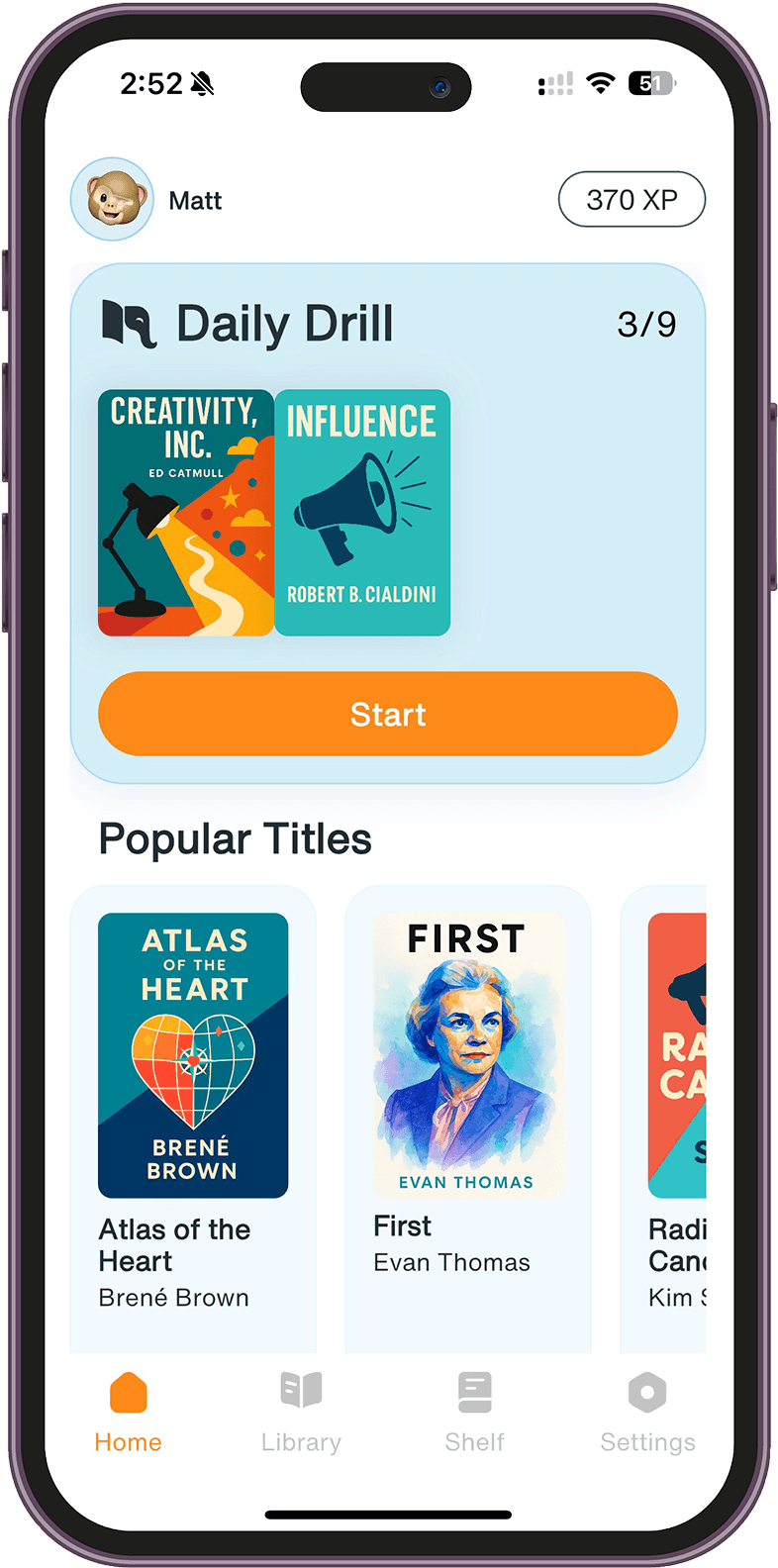
Loxie uses spaced repetition and active recall—the same techniques proven most effective by cognitive science research—to help you internalize concepts so they're available when you need them. Instead of passively re-reading your highlights, you practice retrieving information at precisely timed intervals that cement it into long-term memory.
The process takes just 2 minutes a day. Loxie surfaces questions about Pink's frameworks right before you'd naturally forget them, prompting your brain to reconstruct the knowledge. Each successful recall strengthens the memory trace, and over time, concepts like the new ABCs or the Pixar pitch format become as automatic as riding a bike—available without conscious effort when you're in the middle of a real persuasion situation.
To Sell Is Human is included in Loxie's free topic library, so you can start reinforcing these concepts immediately. The difference between knowing about attunement and actually being attuned in your next negotiation is the difference between reading and retaining. Loxie bridges that gap.
Frequently Asked Questions
What is the main idea of To Sell Is Human?
The central argument is that we're all in sales now, spending roughly 40% of our work time persuading and influencing others. Traditional sales skills have become essential survival skills across all professions, from teachers to doctors to entrepreneurs, making the ability to move others a universal rather than specialized capability.
What are the new ABCs of selling according to Daniel Pink?
The new ABCs are Attunement (perspective-taking and seeing from others' viewpoints), Buoyancy (staying resilient amid inevitable rejection), and Clarity (helping others identify problems they didn't know they had). These replace "Always Be Closing" because information parity has shifted power to buyers.
What are the six types of pitches in To Sell Is Human?
Pink identifies the one-word pitch, the question pitch, the rhyming pitch, the subject-line pitch, the Twitter pitch, and the Pixar pitch. Each leverages different psychological principles and suits different contexts, from extreme brevity to narrative storytelling.
Why does Pink say "seller beware" has replaced "buyer beware"?
The internet gave buyers access to information sellers once hoarded—prices, reviews, alternatives. Customers can now instantly verify claims and share bad experiences globally, making deception too risky and honesty a competitive advantage.
What is the Pixar pitch formula?
The Pixar pitch follows six sentences: "Once upon a time... Every day... Until one day... Because of that... Until finally... Ever since then..." This structure transforms any idea into a compelling narrative that engages emotions and creates memorability.
How can Loxie help me remember what I learned from To Sell Is Human?
Loxie uses spaced repetition and active recall to help you retain key concepts from To Sell Is Human. Instead of reading the book once and forgetting most of it, you practice for 2 minutes a day with questions that resurface ideas right before you'd naturally forget them. Loxie includes this book in its full topic library.
We're an Amazon Associate. If you buy a book through our links, we earn a small commission at no extra cost to you.
Stop forgetting what you learn.
Start learning for good with your 7-day FREE trial.