Transformed: Key Insights & Takeaways from Marty Cagan
Master Marty Cagan's complete framework for building empowered product teams that deliver exceptional value through continuous innovation.
by The Loxie Learning Team
Why do some tech companies consistently deliver products customers love while others struggle to ship features anyone cares about? Marty Cagan's Transformed answers this question by revealing the fundamental operating model that separates the world's most successful product organizations from traditional IT-driven companies. The difference isn't just about better processes—it's about a completely different way of working where teams own outcomes, not outputs.
This guide breaks down Cagan's comprehensive framework for organizational transformation. Whether you're a product leader trying to change how your company builds software, an executive questioning why your digital initiatives keep failing, or a team member wondering why your organization can't seem to innovate, you'll understand the specific principles and practices that enable continuous value delivery.
 Start practicing Transformed free for 7 days ▸
What is the product operating model and why does it matter?
The product operating model is a fundamentally different way of building technology products that replaces traditional feature teams with empowered product teams who own business outcomes. Instead of receiving requirements from stakeholders and executing predetermined feature lists, these teams have the authority to discover what customers actually need, decide how to solve problems, and iterate rapidly based on real usage data.
This model works because it treats technology as the core business driver rather than a support function. Traditional IT organizations create artificial separation between "the business" and "technology," resulting in long feedback loops, misaligned priorities, and products built on assumptions rather than validated customer needs. The product operating model eliminates these barriers by giving cross-functional teams direct access to customers and the autonomy to make decisions based on what they learn.
The four foundational principles of the product operating model work as an integrated system. First, continuous discovery validates ideas before significant resources are invested in building them. Second, cross-functional teams eliminate handoffs between departments that slow decision-making. Third, data guides every decision rather than opinions or organizational politics. Fourth, treating products as ongoing services ensures teams continue improving based on actual usage metrics rather than declaring victory at launch.
What is the difference between empowered product teams and feature teams?
Empowered product teams own business outcomes like revenue growth, customer retention, or problem resolution rates, while feature teams merely deliver outputs like completed user stories or shipped features. This distinction creates vastly different levels of engagement, innovation, and ultimately business impact.
Feature teams operate in a command-and-control model where stakeholders or executives decide what should be built, product managers write requirements, and engineers implement specifications. The team's success is measured by whether they delivered what was asked for, on time and on budget. The fundamental problem is that no one is accountable for whether the feature actually solves a customer problem or moves a business metric.
Empowered teams flip this model entirely. They receive problems to solve and outcomes to achieve, then have full authority to discover and decide on solutions. They test twenty or more solution variations per quarter through rapid prototyping and weekly customer testing cycles, rather than building one predetermined solution and hoping it works. When an approach isn't working, they have permission to pivot without seeking approval through lengthy governance processes.
The engagement difference is profound. Engineers on feature teams often describe their work as "just coding what they're told," while engineers on empowered teams become genuine problem solvers who shape product decisions. This shift in how people experience their work explains why transformed organizations report dramatically higher retention of technical talent.
Practice these concepts in Loxie ▸
Why do traditional IT departments and feature teams fail in modern markets?
Traditional IT departments fail because they separate technology from business strategy, treating software development as a cost center to be managed rather than a capability to be leveraged. This separation creates organizational silos where business stakeholders define requirements based on their assumptions, then "throw them over the wall" to technology teams who build exactly what was specified—even when those specifications are based on flawed understanding of customer needs.
The focus on delivering predetermined features rather than discovering what customers actually need compounds the problem. Traditional organizations spend months creating detailed roadmaps and requirements documents, then measure success by adherence to those plans. But customer needs evolve, competitive landscapes shift, and most importantly, assumptions embedded in those requirements are rarely tested until after significant resources have been invested.
The timeline mismatch is stark. Traditional approaches often require three to six months from idea to customer feedback, while empowered product teams using continuous discovery can test concepts with customers within days. In fast-moving markets, the organization that learns faster wins—and traditional IT structures make learning painfully slow.
How do empowered teams actually own outcomes?
Empowered product teams own outcomes by having three essential authorities: the authority to decide what to build, how to build it, and when to pivot based on customer feedback and business metrics. This is fundamentally different from being told to "take ownership" while still requiring approval for every significant decision.
Outcome ownership starts with how work is assigned. Instead of receiving a list of features to build, teams receive business problems to solve with clear success metrics. A feature team might be told to "build a notification system," while an empowered team would be asked to "increase seven-day user retention from 40% to 55%." The second framing gives the team freedom to explore multiple solutions and obligation to measure whether their work actually moves the metric.
Direct customer access is non-negotiable for outcome ownership. Empowered teams conduct their own user research, run their own experiments, and see firsthand how customers respond to their solutions. They don't rely on secondhand reports from business analysts or satisfaction surveys conducted by other departments. This direct connection to customer reality enables faster learning and better decision-making.
Rapid prototyping and iteration operationalize outcome ownership. Teams build lightweight prototypes to test concepts before committing engineering resources, run experiments to validate assumptions, and pivot quickly when data shows an approach isn't working. The goal isn't to be right the first time—it's to learn faster than competitors and accumulate validated insights that lead to better solutions.
Understanding these frameworks intellectually isn't the same as applying them under pressure.
Loxie uses spaced repetition to help you internalize the distinctions between empowered and feature teams, so you recognize the patterns in your own organization and remember the principles when making decisions.
Start retaining what you learn ▸How should organizations manage stakeholders in the product operating model?
Effective stakeholder management in the product operating model means treating stakeholders as sources of valuable context and constraints while preserving the product team's ability to discover and decide on solutions. Stakeholders bring essential business knowledge, regulatory requirements, and strategic priorities—but they shouldn't be dictating features or approving every product decision.
The shift requires changing what stakeholders communicate to product teams. Instead of feature requests ("we need a dashboard with these twelve charts"), stakeholders share outcome goals ("we need sales teams to identify at-risk accounts before they churn") and constraints ("we must maintain SOC 2 compliance"). This framing gives teams the context they need while preserving their autonomy to find the best solution.
Successful stakeholder collaboration involves regular sharing of learnings and prototypes rather than formal review gates. Teams proactively keep stakeholders informed about what they're learning from customers, show early prototypes to gather input, and explain their reasoning when making significant decisions. This transparency builds trust that the team is working toward shared business goals, reducing stakeholder anxiety about whether their concerns are being addressed.
The key distinction is influence versus control. Stakeholders should absolutely influence product direction through the problems they raise, the metrics they care about, and the constraints they communicate. But they shouldn't control the specific solutions teams pursue or require approval before teams can test new approaches with customers.
What role do engineers play in transformed organizations?
In transformed organizations, engineers become problem solvers and innovators who shape product decisions rather than coders who simply implement predetermined specifications. This represents a fundamental shift in how technical talent is valued and utilized.
Engineers on empowered teams participate in discovery activities alongside product managers and designers. They talk to customers, understand the business context, and contribute ideas for how technology might solve problems in ways non-technical team members wouldn't imagine. Their deep understanding of technical possibilities and constraints makes them invaluable during early solution exploration, not just execution.
This expanded role requires different skills and mindsets. Engineers need to develop curiosity about customer problems, comfort with ambiguity during early discovery phases, and communication skills to explain technical tradeoffs to non-technical colleagues. Organizations investing in transformation must also invest in helping engineers grow into these expanded responsibilities.
The payoff is substantial. When engineers understand why they're building something and have agency in deciding how to build it, code quality improves, technical debt decreases, and retention of technical talent increases dramatically. Engineers who feel like partners in product decisions are far more engaged than those who feel like ticket-takers executing someone else's vision.
How should organizations measure product success after transformation?
Product success measurement shifts from output-based metrics to outcome-focused indicators that actually reflect whether the organization is delivering value. Instead of tracking velocity, feature count, or on-time delivery, transformed organizations measure customer retention, problem resolution rates, time-to-value for new users, and business impact delivered per team.
Meaningful transformation metrics focus on three areas: customer outcomes, team empowerment levels, and time-to-learn. Customer outcome metrics reveal whether products are actually solving problems and creating value. Team empowerment metrics assess whether teams have the authority, capability, and psychological safety to operate as genuinely empowered units. Time-to-learn metrics measure how quickly teams can test assumptions and incorporate customer feedback into their work.
The danger of traditional metrics is that they can be gamed without improving results. A team can increase velocity by taking on smaller tickets, ship more features that no one uses, or hit deadlines by cutting corners that create technical debt. Outcome-focused metrics are harder to game because they require actually delivering value to customers and the business.
The best product companies also measure experimentation rates and learning velocity. How many experiments is each team running per month? How quickly can a team go from hypothesis to validated learning? These leading indicators predict future success better than lagging output metrics.
What does successful transformation actually look like in practice?
Successful transformation case studies reveal that companies achieve ten-fold improvements in time-to-market, customer satisfaction, and innovation capacity when they fully commit to empowered product teams with strong product leadership and genuine engineering partnership. These results aren't marketing claims—they're documented outcomes from organizations that made the transition.
The transformation journey typically unfolds in three predictable phases. The foundation-building phase (three to six months) involves training, piloting with selected teams, and establishing new ways of working. The early wins phase (six to twelve months) demonstrates results from pilot teams and builds organizational confidence in the new model. The scaling phase (twelve to twenty-four months or more) extends the model across the organization while continuously adapting based on what's learned.
Most organizations should expect twelve to twenty-four months for initial results and two to three years for full transformation. Leaders who expect faster results often declare victory too early or abandon the effort when inevitable challenges arise. Setting realistic expectations upfront and maintaining commitment through difficult periods separates successful transformations from abandoned initiatives.
The compound effect of transformation becomes visible over time. Early improvements in customer feedback loops enable better product decisions, which lead to better customer outcomes, which generate more organizational commitment to the new model, which enables further investment in empowered teams. This virtuous cycle accelerates as the transformation matures.
What structural changes does transformation require?
Successful transformation requires dismantling command-and-control hierarchies, shifting from project-based to product-based funding, and building a culture where teams are genuinely trusted to solve problems rather than just implement approved solutions. Process changes without these structural shifts will eventually revert under organizational pressure.
The funding model shift is particularly important. Project-based funding creates artificial pressure to deliver predetermined scope within fixed timelines, directly conflicting with the continuous discovery and iteration that empowered teams need. Product-based funding gives persistent teams stable resources to pursue outcomes over time, enabling the kind of experimentation and learning that drives innovation.
Governance structures must also evolve. Traditional stage-gate reviews that require executive approval before teams can proceed create bottlenecks that slow learning and signal distrust. Transformed organizations replace these with outcome-based accountability where teams have freedom to pursue goals as they see fit, with regular check-ins focused on learnings and results rather than permission-seeking.
The most challenging structural change is often in leadership behavior. Executives accustomed to approving initiatives and directing priorities must learn to set context, define outcomes, and then step back and let teams operate. This requires genuine trust in teams and willingness to tolerate approaches leaders might not have chosen themselves.
How do people-centered transformation strategies work?
People-centered transformation strategies build sustainable change by addressing emotional needs, creating psychological safety, and establishing new behavioral norms rather than just implementing new processes. Change that ignores the human dimension typically fails when pressure mounts and people revert to familiar patterns.
Psychological safety is foundational. Teams won't experiment, admit uncertainty, or challenge stakeholder assumptions unless they feel safe doing so. Leaders must explicitly create permission to fail during discovery, celebrate learning from unsuccessful experiments, and protect teams from blame when validated approaches don't produce expected results.
Transformation communication must cascade clearly through all organizational levels, with role-specific training programs that help people understand how their work changes. Generic announcements about "becoming more agile" or "empowering teams" mean nothing without concrete guidance on new behaviors, decision rights, and success criteria for each role.
Resistance is natural and should be managed proactively rather than suppressed. Early wins demonstrate that the new model works, visible leadership support signals organizational commitment, and continuous coaching helps people build new skills and confidence. People resist change when they fear incompetence or loss of status—addressing these concerns directly accelerates adoption.
How do organizations sustain transformation success over time?
Sustained transformation success requires embedding new practices into performance reviews, promotion criteria, and daily rituals to make the new operating model the path of least resistance. Without this institutionalization, organizations drift back toward familiar patterns when transformation champions leave or priorities shift.
The best product companies treat their operating model as a product itself, continuously experimenting with practices, measuring their impact, and evolving based on what accelerates customer value delivery. This meta-learning approach ensures the organization doesn't freeze its operating model at whatever state it reached during initial transformation.
Continuous coaching and regular retrospectives help teams maintain and improve their practices. When teams face pressure, they naturally revert to familiar behaviors—coaching provides the support needed to stay on the new path. Systematic removal of obstacles that cause regression is equally important: if teams consistently hit roadblocks that reward old behaviors, the operating model must adapt to remove those barriers.
Transformation momentum requires ongoing investment in capability building as team membership changes and new challenges emerge. Organizations that treat transformation as a one-time project rather than an ongoing capability eventually see their gains erode as institutional memory fades and new employees join without understanding the principles behind current practices.
What are the most common transformation mistakes to avoid?
The most common transformation mistakes include treating it as just a process change, underinvesting in coaching, declaring victory too early, and failing to change leadership behaviors and incentives. Organizations that avoid these pitfalls dramatically increase their chances of sustainable success.
Process-only transformation fails because new practices without new mindsets and structures create surface-level change that collapses under pressure. Adopting discovery ceremonies or changing team structures accomplishes nothing if leaders still dictate features, stakeholders still require approval gates, and engineers are still excluded from strategic decisions.
Underinvesting in coaching is particularly damaging. Teams learning new ways of working need ongoing support, not just initial training. Without coaches who can help teams navigate challenges, model new behaviors, and provide just-in-time guidance, teams struggle to translate conceptual understanding into effective practice.
Declaring victory too early often happens when pilot teams show promising results. Leaders eager to demonstrate success scale prematurely before understanding what made pilots succeed or whether those conditions can be replicated across the organization. Failed scaling attempts then discredit the transformation effort and make future attempts harder.
The real challenge with Transformed
Cagan's framework is comprehensive and compelling—but knowing these principles intellectually is vastly different from applying them in the pressure of real organizational dynamics. How much of this guide will you actually remember next week when you're in a meeting with a stakeholder demanding features? How about next month when you're designing a new team structure?
Research on the forgetting curve shows we lose roughly 70% of new information within 24 hours without active reinforcement. The irony is painful: you might read about building learning organizations while failing to retain what you've learned. How many leadership books have you read that felt transformative in the moment but left almost no lasting impact on your actual decisions?
The concepts in Transformed are precisely the type that matter most to retain—frameworks for recognizing organizational dysfunction, principles for structuring teams, and criteria for measuring genuine progress. These are insights you'll need months or years from now, not just during your initial enthusiasm after reading the book.
How Loxie helps you actually remember what you learn
Loxie uses spaced repetition and active recall—the two most scientifically validated learning techniques—to help you move knowledge from short-term recognition to long-term retention. Instead of reading these concepts once and hoping they stick, you practice retrieving them at precisely timed intervals that strengthen memory before it fades.
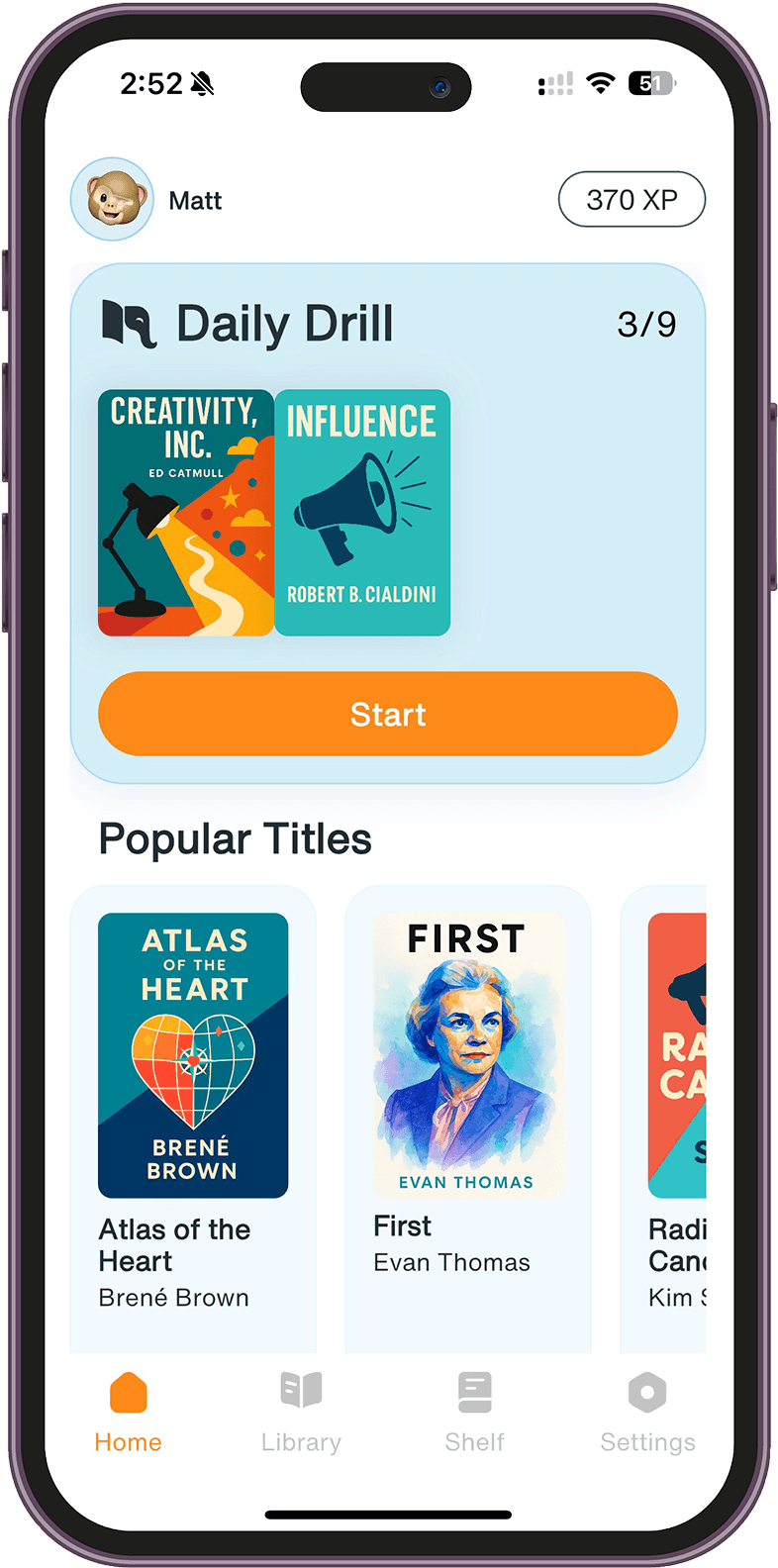
The daily practice takes just two minutes. Loxie surfaces questions about key concepts like the difference between empowered and feature teams, the four principles of the product operating model, and effective stakeholder management strategies. Each time you retrieve an answer, you reinforce the neural pathways that make that knowledge accessible when you actually need it.
Transformed is available in Loxie's free topic library, so you can start reinforcing these concepts immediately without any cost. Whether you're preparing to lead a transformation initiative or simply trying to improve how your team works, having these frameworks genuinely available in your memory—not just saved in your notes—makes the difference between understanding and actually applying what you've learned.
Frequently Asked Questions
What is the main idea of Transformed?
Transformed argues that the world's most successful tech companies use a fundamentally different operating model built on empowered product teams that own business outcomes rather than feature delivery. This model replaces traditional command-and-control structures with autonomous teams that continuously discover what customers need and iterate rapidly based on real data.
What is the difference between empowered product teams and feature teams?
Empowered product teams own business outcomes like retention or revenue growth and have authority to decide what to build, while feature teams merely deliver predetermined outputs like completed user stories. Empowered teams test multiple solutions through rapid experimentation; feature teams build what they're told and hope it works.
What are the four principles of the product operating model?
The four principles work as an integrated system: continuous discovery validates ideas before building, cross-functional teams eliminate departmental handoffs, data guides every decision rather than opinions, and treating products as services ensures continuous improvement based on actual usage metrics after launch.
How long does product transformation typically take?
Organizations should expect twelve to twenty-four months for initial results and two to three years for full transformation. The journey unfolds in three phases: foundation building (three to six months), early wins and learning (six to twelve months), and scaling the model across the organization (twelve to twenty-four months or more).
What are the most common transformation mistakes?
The most common mistakes include treating transformation as just a process change without addressing mindsets and structures, underinvesting in coaching, declaring victory too early after initial pilot success, and failing to change leadership behaviors and incentives that inadvertently reward old patterns.
How can Loxie help me remember what I learned from Transformed?
Loxie uses spaced repetition and active recall to help you retain the key concepts from Transformed. Instead of reading the book once and forgetting most of it, you practice for 2 minutes a day with questions that resurface ideas right before you'd naturally forget them. Loxie includes Transformed in its full topic library.
We're an Amazon Associate. If you buy a book through our links, we earn a small commission at no extra cost to you.
Stop forgetting what you learn.
Start learning for good with your 7-day FREE trial.