What Got You Here Won't Get You There: Key Insights & Takeaways
Master Marshall Goldsmith's framework for identifying and changing the habits that limit your leadership growth.
by The Loxie Learning Team
What if the very habits that made you successful are now holding you back? Marshall Goldsmith's What Got You Here Won't Get You There reveals an uncomfortable truth: the behaviors that earned you promotions, accolades, and your current position can become the exact things preventing you from reaching the next level. The perfectionism that made you a star individual contributor? It's now micromanaging your team into disengagement.
This guide breaks down Goldsmith's complete framework for identifying and eliminating the interpersonal habits that derail leadership careers. Whether you're a rising executive sensing you've plateaued or a leader wanting to understand why talented people stall, you'll learn not just what behaviors to change, but the systematic process for actually making change stick.
 Start practicing these concepts free for 7 days ▸
Why do the skills that made you successful stop working at higher levels?
The skills and behaviors that earned your current success become self-limiting at higher levels because leadership fundamentally shifts from delivering results yourself to achieving through others. What got you promoted—your hands-on problem-solving, your competitive drive, your perfectionism—worked when success meant personal output. But at senior levels, success means multiplying value through people rather than adding it yourself.
This paradox explains why so many talented individuals plateau. The traits that made them indispensable contributors become counterproductive when their role demands enabling others' success rather than proving their own expertise. A brilliant engineer who solved every hard problem herself now leads a team that waits for her input instead of developing their own capabilities. Her strength became her limitation.
Goldsmith's research with thousands of executives revealed something important: career derailment at senior levels rarely stems from lack of skills or knowledge. It stems from interpersonal habits that damage relationships and team effectiveness. The technical competence that opened doors becomes table stakes, while behavioral change becomes the key differentiator.
What are the 20 habits that derail executive careers?
Twenty specific interpersonal habits derail executive careers, and they all stem from the same root: prioritizing being right over being effective. These aren't skill deficits—they're behavioral patterns that damage relationships and undermine the trust leaders need to achieve through others. Understanding these habits is the first step to identifying which ones might be limiting your own growth.
The Need to Win Too Much
Winning too much means turning every interaction into a competition—from boardroom debates to restaurant choices to casual conversations. Leaders with this habit exhaust their teams and transform colleagues into combatants rather than collaborators. The irony is that this compulsive competitiveness, often rewarded early in careers, becomes destructive in leadership roles where creating winners matters more than being the winner. These leaders compete even when winning damages their larger goals.
Adding Too Much Value
Adding too much value represents the most common executive trap because it feels helpful while actually destroying initiative and engagement. When you improve every idea by 5%, you reduce ownership by 50%. The leader who can't resist tweaking every suggestion trains their team to bring half-baked ideas and wait for the boss's input. Instead of developing future leaders, they create order-takers dependent on their direction.
Starting with "No," "But," or "However"
These three words secretly communicate "I'm right, you're wrong" regardless of what follows. Leaders use these verbal habits as unconscious dominance displays to maintain intellectual superiority. Each correction reduces the likelihood of hearing diverse perspectives or early warnings about problems. People learn to stop offering ideas rather than face constant contradiction.
Other Career-Limiting Habits
The remaining habits include: passing judgment on others, making destructive comments, telling the world how smart you are, speaking when angry, negativity ("Let me explain why that won't work"), withholding information, failing to give proper recognition, claiming undeserved credit, making excuses, clinging to the past, playing favorites, refusing to express regret, not listening, failing to express gratitude, punishing the messenger, passing the buck, and the catch-all "an excessive need to be me."
Practice identifying these habits in Loxie ▸
Why does success create its own trap?
Success creates its own trap because the more your methods work, the more you attribute success solely to your approach while becoming blind to changing contexts, lucky timing, and others' contributions. This creates rigidity precisely when adaptability matters most.
This success delusion explains why high achievers often struggle with transitions. They've internalized a story where their specific behaviors caused their success. Changing those behaviors feels like abandoning a winning formula, even when the environment, role, or requirements have fundamentally shifted. The successful salesperson promoted to sales manager keeps selling instead of coaching because selling is what made them successful.
Four dangerous beliefs trap successful people in this pattern. "I have succeeded" creates overconfidence. "I can succeed" leads to over-commitment and taking on too much. "I will succeed" produces magical thinking about outcomes. "I choose to succeed" generates an illusion of control that makes leaders blame external factors rather than examining their own behavior. These beliefs form an interlocking system where past success justifies ignoring feedback.
How does the gap between self-perception and reality widen with each promotion?
The gap between how you see yourself and how others experience you widens with each promotion because power insulates you from honest feedback while amplifying the impact of your worst behaviors. As leaders rise, people become less likely to point out flaws while simultaneously becoming more affected by them.
This creates a dangerous blind spot where minor irritating habits evolve into major leadership derailers without the leader's awareness. The executive who thinks she's "direct" doesn't hear that her team experiences her as "brutal." The leader who believes he's "high-standards" doesn't realize his team sees "impossible to please." Success itself becomes the barrier to the self-awareness needed for growth.
Successful people systematically overvalue their own contributions—believing they contribute 80% when teammates say 40%—because they remember their work vividly while minimizing others' contributions they didn't directly observe. This attribution bias becomes more pronounced with success, as leaders unconsciously edit their memories to emphasize their role in victories while attributing failures to external factors.
Reading about these blind spots is just the first step
The real challenge is catching yourself in the moment when these habits appear. Loxie uses spaced repetition to help you internalize these concepts so you can recognize your patterns before they limit your growth.
Try Loxie free for 7 days ▸What is goal obsession and why is it dangerous for leaders?
Goal obsession means achieving objectives at any cost, causing leaders to win battles while losing wars. They damage relationships, reputation, and trust in pursuit of narrow metrics without recognizing that the relationships destroyed and trust eroded while hitting targets ultimately undermine their ability to achieve future goals.
This tunnel vision makes executives sacrifice long-term sustainability for short-term achievement. The sales leader who hits quota by poaching colleagues' accounts creates short-term numbers but long-term organizational dysfunction. The project manager who delivers on deadline by burning out the team loses the people needed for the next project.
The sunk cost fallacy compounds this problem. Once leaders publicly commit to goals, changing course requires admitting error—which their success-based identity resists. They double down on bad strategies rather than pivot, leading to spectacular failures where everyone except the leader sees the iceberg ahead.
What is the seven-step process for changing behavior?
Behavioral change requires a systematic seven-step process: feedback, apologizing, advertising, listening, thanking, following up, and feedforward. This structured approach works because it addresses both internal resistance and external perception—public commitment and consistent reinforcement overcome our natural tendency to revert to old patterns.
Step 1: Gather Feedback
The process starts with understanding how others actually experience you, not how you intend to come across. This requires soliciting honest input from colleagues, direct reports, and peers—people who see your behavior in action. Many leaders are shocked by the gap between their self-image and external perception.
Step 2: Apologize
Effective apologies require no explanations or qualifications—just "I'm sorry, I'll try to do better." Adding context sounds like excuses and diminishes the apology's power. Leaders instinctively want to explain their behavior to show they're not bad people, but recipients experience explanations as minimizing the impact. Simple, unqualified apologies reset relationships.
Step 3: Advertise Your Commitment
Telling everyone what you're working on transforms private intention into public accountability. This counterintuitive step leverages social pressure positively: when everyone knows you're trying to listen better, they notice attempts and appreciate progress. This creates a feedback loop that reinforces the new behavior and makes relapse socially expensive.
Step 4: Listen Without Judgment
Listening without interrupting, correcting, or finishing sentences—even when you know what's coming—demonstrates respect more powerfully than words. The discipline of letting others complete their thoughts, especially when you disagree, transforms you from judge to colleague. It creates psychological safety that enables people to share real concerns rather than filtered versions.
Step 5: Thank People for Feedback
Thanking people for feedback—especially criticism—rather than defending or explaining, transforms potentially damaging interactions into relationship-building moments. When leaders thank critics instead of rebutting, they create an environment where people share problems early rather than hiding them until crisis. Gratitude for feedback becomes a strategic advantage disguised as courtesy.
Step 6: Follow Up Consistently
Following up monthly—asking "How am I doing on my commitment to change?"—maintains momentum by showing seriousness, inviting ongoing feedback, and preventing the natural drift back to old patterns. This follow-up process itself drives improvement: knowing someone will ask about your listening makes you listen better. Their attention to your progress reinforces the new behavior.
Step 7: Practice Feedforward
Feedforward means asking for future suggestions rather than past feedback. This eliminates defensiveness because you can't argue with someone's ideas about tomorrow the way you instinctively defend yesterday's actions. The technique bypasses the ego's defense mechanisms by focusing on possibilities rather than problems, making people more receptive to input.
Learn this change process in Loxie ▸
Why do interpersonal skills matter more than technical skills at senior levels?
As you rise in organizations, technical skills become table stakes while interpersonal skills become differentiators—yet most professional development still focuses on expertise rather than behavior. The Peter Principle occurs not because people lack technical competence at higher levels, but because they never develop the interpersonal skills required when success depends on influencing without authority and achieving through others.
The "smart person syndrome" makes talented individuals fail as leaders because they rely on being right rather than building relationships. High performers often get promoted for individual brilliance, then struggle when success requires emotional intelligence, collaboration, and the humility to let others shine—skills their achievement-focused development never addressed.
Making destructive comments—using sarcasm, cutting remarks, or "brutal honesty"—creates permanent damage that no amount of subsequent praise can repair. Leaders justify these comments as "keeping people sharp" or "maintaining high standards," not recognizing that fear-based motivation destroys the psychological safety required for innovation, risk-taking, and honest communication.
What is feedforward and why is it more effective than traditional feedback?
Feedforward asks for future suggestions rather than critiques of past behavior. The two-question feedforward process—"What should I keep doing?" and "What should I change?"—generates actionable insights in under two minutes while avoiding the emotional baggage of traditional performance reviews.
This simple framework works because it balances affirmation with improvement, focuses on behavior rather than personality, and treats development as ongoing rather than event-based. People become more creative in their suggestions since they're building possibilities rather than criticizing failures. It makes continuous improvement feel natural rather than threatening.
Traditional feedback triggers defensiveness because it asks you to revisit and justify past decisions. Feedforward sidesteps this entirely. You can't argue with someone's ideas about what you might do tomorrow—there's nothing to defend. This psychological difference makes the input more usable and the conversation more constructive.
Why does following up transform perception into reality?
Following up transforms perception into reality because the act of consistently asking about your progress makes people notice improvements they might have missed. This creates change through observation alone—the Hawthorne effect applied to behavioral development.
Regular follow-up transforms change from an event to a process. It demonstrates that the leader values others' perceptions enough to keep asking, which itself improves relationships regardless of the specific behavior being changed. The follow-up shows seriousness and invites ongoing calibration.
Gratitude creates a positive recall bias that compounds over time. When you consistently thank people, they remember you as appreciative even if you occasionally forget. Those who rarely thank are remembered as ungrateful despite occasional recognition. Building a "gratitude bank account" through consistent appreciation creates resilience in relationships, allowing leaders to make occasional mistakes without damaging their reputation.
The real challenge with What Got You Here Won't Get You There
Here's the uncomfortable truth about leadership books: recognizing these patterns intellectually is easy. Catching yourself in the moment when you're about to add "just one small improvement" to someone's idea? That's the hard part. The concepts in this book are only useful if you can access them when your habits are actually triggered.
How many leadership insights have you learned that you can't recall three months later? How many books have felt life-changing in the moment but left no lasting trace on your actual behavior? The forgetting curve works against everyone—within a week, you'll have forgotten most of what you read here unless you actively work to retain it.
The irony is that behavioral change requires remembering the concepts long enough to interrupt your automatic responses. You can't apply the seven-step process if you can't remember the steps. You can't catch yourself "winning too much" if the concept isn't top of mind when your competitive instincts kick in.
How Loxie helps you actually remember and apply these concepts
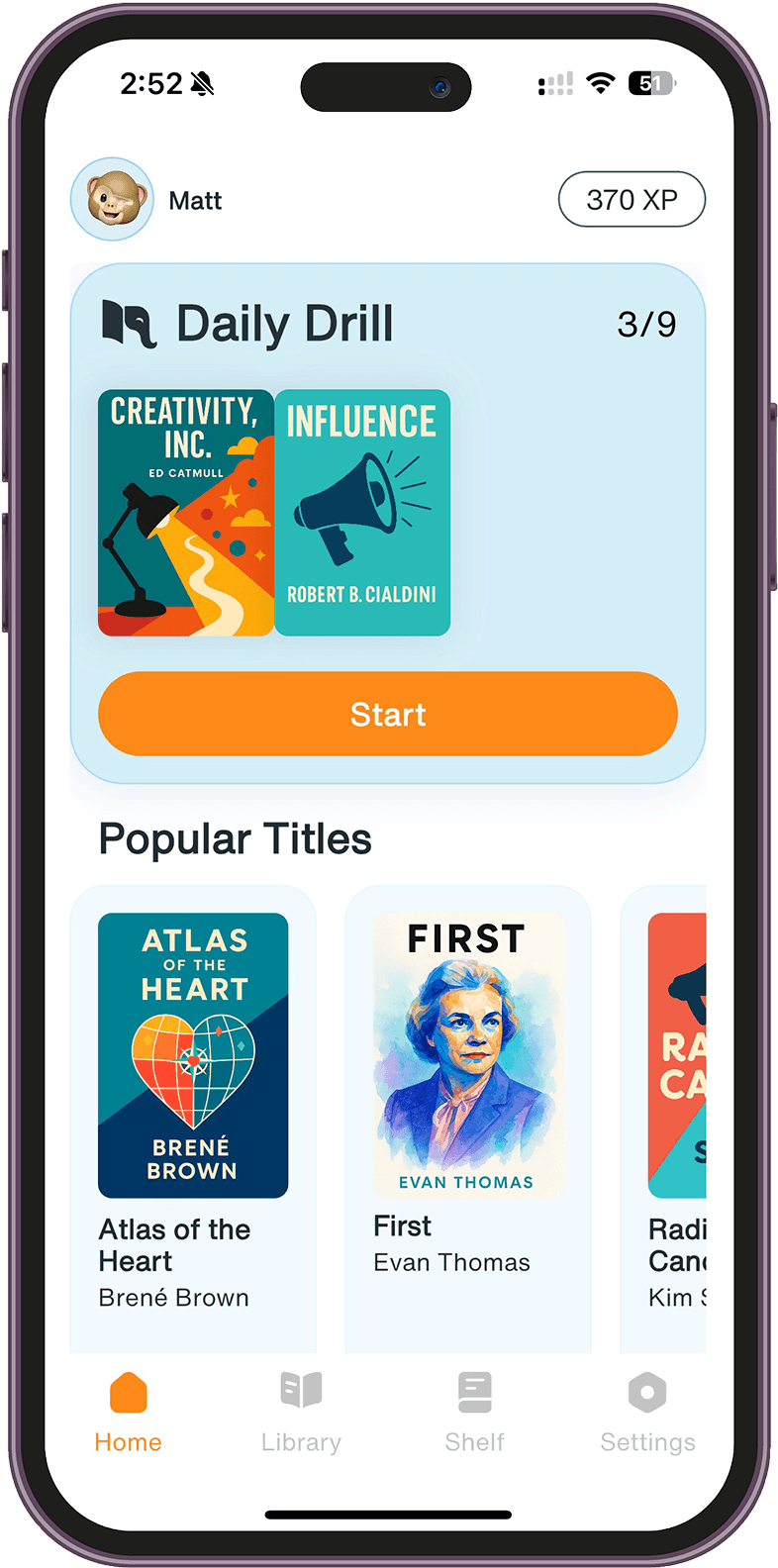
Loxie uses spaced repetition and active recall to help you internalize the key concepts from What Got You Here Won't Get You There. Instead of reading the book once and hoping the ideas stick, you practice for just 2 minutes a day with questions that resurface concepts right before you'd naturally forget them.
This isn't passive review—it's active engagement that strengthens the neural pathways connecting these concepts to your real-world situations. When you're about to interrupt someone in a meeting, the concept of "listening without adding value" will be accessible because you've practiced retrieving it repeatedly.
Loxie includes this book's content in its full topic library, so you can start reinforcing these leadership concepts immediately. The gap between knowing and doing starts with actually remembering what you've learned.
Frequently Asked Questions
What is the main idea of What Got You Here Won't Get You There?
The central idea is that the habits and behaviors that made you successful at one level often become the very things limiting your growth at the next level. Leadership success shifts from delivering results yourself to achieving through others, requiring you to change behaviors that once served you well.
What are the 20 habits that derail executive careers?
The 20 habits include: winning too much, adding too much value, passing judgment, making destructive comments, starting with "no/but/however," telling the world how smart you are, speaking when angry, negativity, withholding information, failing to give recognition, claiming undeserved credit, making excuses, clinging to the past, playing favorites, refusing to express regret, not listening, failing to express gratitude, punishing the messenger, passing the buck, and an excessive need to be "me."
What is the seven-step process for behavioral change?
The seven steps are: (1) gather feedback to understand how others experience you, (2) apologize without explanation, (3) advertise your commitment to change publicly, (4) listen without judgment, (5) thank people for feedback, (6) follow up consistently to maintain momentum, and (7) practice feedforward by asking for future suggestions.
What is feedforward and how does it differ from feedback?
Feedforward asks for suggestions about future behavior rather than critiques of past actions. It eliminates defensiveness because you can't argue with ideas about what you might do tomorrow. This makes people more receptive to input and more creative in their suggestions since they're building possibilities rather than criticizing.
Why does "adding too much value" hurt teams?
When leaders improve every idea by 5%, they reduce ownership by 50%. Team members learn to bring half-baked ideas and wait for the boss's input. Instead of developing future leaders, this habit creates dependent order-takers who stop taking initiative because their ideas will be changed anyway.
How can Loxie help me remember what I learned from What Got You Here Won't Get You There?
Loxie uses spaced repetition and active recall to help you retain the key concepts from this book. Instead of reading once and forgetting most of it, you practice for 2 minutes a day with questions that resurface ideas right before you'd naturally forget them. Loxie includes this book in its full topic library.
We're an Amazon Associate. If you buy a book through our links, we earn a small commission at no extra cost to you.
Stop forgetting what you learn.
Start learning for good with your 7-day FREE trial.