Writing Concisely: Key Concepts & What You Need to Know
Master the discipline of clarity that makes every word earn its place—communicate more by saying less.
by The Loxie Learning Team
In our information-saturated world, every email competes with a hundred others for attention. Every report fights for reading time against meetings, messages, and deadlines. The writers who get read—and get results—aren't necessarily the smartest or most knowledgeable. They're the ones who respect their reader's time by delivering maximum value per word.
Writing concisely isn't about dumbing down your message or stripping away nuance. It's about disciplined clarity—ensuring every word earns its place on the page. This guide covers the essential techniques: the one-idea-per-sentence principle that prevents confusion, systematic approaches for cutting wordiness, front-loading strategies that capture busy readers, and document structures that survive even partial reading.
 Start practicing concise writing ▸
What is the one-idea-per-sentence principle?
The one-idea-per-sentence principle means each sentence should convey a single distinct thought. This prevents reader confusion because readers process information sequentially—mixing multiple ideas in one sentence forces them to mentally separate and reconnect concepts, increasing cognitive load and reducing comprehension.
This principle works because human working memory can only hold 7±2 items at once. When sentences contain multiple ideas, readers must simultaneously parse grammar, extract meaning, and track relationships between concepts. By limiting sentences to one idea, you align with natural cognitive processing, allowing readers to fully grasp each point before moving to the next.
Where should you split compound sentences?
Coordinating conjunctions—'and,' 'but,' 'or'—joining independent clauses signal natural breaking points where one sentence should become two. When you see 'The team completed the analysis and the results show significant savings,' split at 'and' to isolate each complete thought for clearer comprehension.
This creates 'The team completed the analysis. The results show significant savings.' The separation allows readers to register the accomplishment before processing its implications, preventing the common error of skimming past achievements to focus only on outcomes. Understanding where to split sentences is one thing—remembering to apply it consistently requires deliberate practice, which is exactly what Loxie's spaced repetition system reinforces.
How does visual hierarchy improve readability?
Dense text blocks hide document structure and force linear reading when readers often need specific information. Breaking at topic shifts with white space creates visual hierarchy that enables scanning, letting readers jump directly to relevant sections rather than parsing every word to find what they need.
Research shows readers scan business documents in an F-pattern, focusing on headings and paragraph openings. Dense blocks defeat this natural scanning behavior by hiding transition points between topics. Adding paragraph breaks at topic boundaries creates visual anchors that guide navigation. A 500-word block about three different project phases becomes three scannable 160-word sections, each with clear focus, dramatically improving information retrieval speed.
Practice these techniques in Loxie ▸
What are redundant phrase pairs and how do you eliminate them?
Redundant phrase pairs like 'advance planning,' 'past history,' and 'end result' contain words that duplicate meaning. 'Planning' already means preparing in advance. 'History' is always past. 'Result' implies an end. The modifiers are unnecessary padding that trained editors delete systematically.
These redundancies persist because they sound natural in speech where repetition aids clarity. In writing, they waste space and slow reading. Create a personal list of redundant pairs you use habitually: 'combine together,' 'free gift,' 'future forecast,' 'unexpected surprise.' Search documents for these patterns during editing. Removing redundant modifiers from a typical business document cuts 3-5% of words without losing any meaning.
Why do intensifiers weaken your writing?
Intensifiers like 'very,' 'really,' and 'quite' weaken statements by suggesting the base word isn't strong enough. Replace 'very important' with 'critical,' 'really big' with 'massive,' and 'quite difficult' with 'challenging' to convey intensity through word choice rather than modification.
When you write 'very important,' readers sense you're compensating for 'important' not being strong enough. Strong writers select precise words that carry intended intensity: 'crucial,' 'vital,' 'essential.' This forces clearer thinking about actual importance levels. Mark Twain advised: 'Substitute 'damn' every time you're inclined to write 'very;' your editor will delete it and the writing will be just as it should be.'
What is throat-clearing and why should you eliminate it?
Throat-clearing introductions like 'I am writing to inform you that' or 'The purpose of this email is to' waste the opening sentence where readers decide whether to continue. Starting directly with your main point—'The project deadline has moved to March 15'—captures attention before readers' focus fades.
Email preview panes show only 50-100 characters, and readers spend 8 seconds deciding whether to read fully. Throat-clearing wastes this critical real estate on obvious statements. 'I am writing to inform you that the project deadline has moved' becomes 'Project deadline moved to March 15' in the preview, immediately conveying value. This direct approach increases open rates and response rates by ensuring key information appears even in preview.
Knowing these rules isn't the same as applying them
Most people read about concise writing techniques once, nod along, then return to old habits within days. Loxie uses spaced repetition to keep these principles active in your memory so they become automatic when you write.
Build lasting writing habits ▸How do you compress wordy prepositional phrases?
Wordy prepositional phrases systematically compress to single words. 'In order to' becomes 'to.' 'In the event that' becomes 'if.' 'For the purpose of' becomes 'for.' 'With regard to' becomes 'about.' These substitutions cut 50-75% of words while preserving exact meaning.
These inflated phrases create false formality that obscures meaning. They multiply in corporate writing where writers mistake wordiness for sophistication. Create a replacement chart for editing: 'at this point in time' → 'now,' 'due to the fact that' → 'because,' 'in close proximity to' → 'near.' A typical business document contains 20-30 replaceable phrases. Systematic substitution cuts 100+ words from a 10-page report without losing any content.
What is the 'so what?' test for cutting content?
The 'so what?' test identifies dispensable content by forcing you to justify each sentence's contribution. If removing a sentence doesn't create logical gaps or lose essential information, it's padding that dilutes impact—like general observations readers already know or transitional phrases that state the obvious.
Apply this test paragraph by paragraph, asking 'What would readers lose if I cut this?' Sentences that provide common knowledge ('Communication is important in business'), obvious transitions ('Now let's move to the next point'), or repetitive emphasis ('As previously mentioned') typically fail the test. A 1,000-word document often contains 150-200 words of padding. Removing these strengthens remaining content by increasing the signal-to-noise ratio.
Start retaining what you learn ▸
How do you combine related short sentences effectively?
Combining related short sentences through subordination eliminates repetition while improving flow. 'The report is complete. It contains three sections. It analyzes Q3 performance' becomes 'The complete three-section report analyzes Q3 performance.' This cuts words while creating smoother reading rhythm.
Short sentences provide clarity but create choppy reading when overused. Combining related ideas through subordination (making one idea dependent on another) maintains clarity while improving flow. The key is combining only directly related ideas—forcing unrelated concepts together violates the one-idea principle. Look for repeated subjects ('The team... The team... The team...') as combination opportunities. This technique typically reduces word count by 20-30% while improving readability.
What is front-loading and why does it matter?
Front-loading puts your main message in the first two sentences where readers decide whether to continue. Busy executives receiving 100+ emails daily triage by scanning openings. Burying your key point in paragraph three means it often goes unread, causing delays or missed actions.
Eye-tracking studies show readers spend 60% of time on the first third of emails. Starting with context or background pushes key information below the fold where engagement drops 75%. Lead with what matters most: the decision needed, the problem discovered, the deadline changed. Context follows for those who need it. This inverted approach feels unnatural but dramatically improves response rates because readers immediately understand what's being asked of them.
How does the inverted pyramid structure work?
The inverted pyramid structure from journalism puts conclusions first, supporting evidence second, and background last. This ensures core message delivery even if readers stop halfway through, reversing the academic pattern of building to conclusions that loses impatient business readers.
Newspapers developed this structure knowing readers rarely finish articles. Business readers behave similarly—engagement drops 50% after the first screen of text. Starting with conclusions feels like spoiling the ending, but business readers want answers, not suspense. 'We should acquire TechCorp for $2M' opens the document, followed by financial justification, then market analysis. Readers get value proportional to time invested rather than nothing until they reach the end.
How do you write action-oriented subject lines?
Action-oriented subject lines replace vague topics with specific requirements. 'FYI: Budget Meeting Notes' becomes 'Action Required: Approve Q4 budget by Friday 3pm.' This immediately signals what recipients must do rather than forcing them to open emails to discover obligations.
Subject lines function as email's user interface, determining open priority and response speed. Vague subjects like 'Update' or 'Question' provide no actionable information, forcing readers to open everything to avoid missing critical items. Specific subjects enable inbox triage: 'Decision Needed,' 'FYI Only,' 'Response Required by [date].' When every email clearly signals its ask, readers trust your communications won't waste time—and your response rates increase accordingly.
Why does active voice make writing stronger?
Active voice places the actor before the action, clarifying responsibility and reducing word count. 'The report was submitted by the team' becomes 'The team submitted the report.' This eliminates ambiguity about who did what while cutting unnecessary words from every sentence.
Passive voice obscures agency and inflates word count by 20-30% on average. It requires helper verbs ('was,' 'been,' 'being') plus prepositions ('by') that active voice eliminates. More importantly, passive construction allows writers to hide responsibility: 'Mistakes were made' versus 'I made mistakes.' Active voice forces accountability and clarity. Studies show active voice improves reading speed by 15% and comprehension by 20% because readers don't need to mentally reconstruct who did what.
How do bullet points and headings improve documents?
Bullet points transform dense paragraphs into scannable chunks by isolating each point visually. Readers process listed items 60% faster than paragraph text because the format eliminates the need to identify boundaries between ideas while providing clear visual hierarchy.
Lists leverage visual processing to accelerate comprehension. When ideas are buried in paragraphs, readers must parse grammar to identify where one point ends and another begins. Bullets provide pre-parsed information, letting readers focus on content rather than structure. Research shows readers retain 40% more from bulleted lists than paragraph form. Use bullets for any series of 3+ related items: steps, options, examples, requirements.
What makes headings effective?
Descriptive headings that summarize content enable selective reading. 'Background' becomes 'Why Marketing Spend Increased 40% in Q3' so readers can jump to relevant sections without reading everything to find what they need, respecting varying information needs.
Generic headings force linear reading because readers can't predict content. Descriptive headings function like a table of contents distributed throughout the document. Instead of 'Analysis,' write 'Three Factors Driving Customer Churn.' Instead of 'Recommendations,' write 'Invest $2M in Retention Programs.' Well-written headings let readers extract exactly what they need in minimal time.
What is multi-pass editing and why does it work?
Multi-pass editing separates structural revision (content organization), line editing (sentence improvement), and copy editing (error correction). Attempting all three simultaneously reduces effectiveness because each requires different cognitive focus, like trying to paint while hammering nails.
Each editing type engages different brain functions. Structural editing requires big-picture thinking about logic and flow. Line editing focuses on sentence-level clarity and concision. Copy editing demands detailed attention to grammar and spelling. Combining them creates cognitive overload that misses problems at all levels. First pass: reorganize sections and paragraphs. Second pass: improve individual sentences. Third pass: fix mechanical errors. This separation improves editing quality by 40%.
Why should you read your writing aloud?
Reading text aloud exposes awkward phrasing and unnecessary words that silent reading misses. Stumbling while reading or running out of breath mid-sentence signals that restructuring is needed, providing a biological test for sentence clarity.
Your brain autocorrects problems when reading silently, filling in missing words and smoothing awkward constructions. Reading aloud bypasses this correction, revealing actual text problems. If you stumble, readers will too. If you need multiple breaths for one sentence, it's too long. This technique catches 50% more clarity issues than silent editing—professional writers and editors consider it essential.
The real challenge with writing concisely
You've now learned the core techniques: one-idea sentences, redundancy elimination, front-loading, active voice, visual hierarchy, and multi-pass editing. These principles can transform your writing from forgettable to compelling. But here's the uncomfortable truth: within a week, you'll forget most of what you just read.
This isn't a failure of effort or intelligence. It's how human memory works. The forgetting curve shows we lose 70% of new information within 24 hours unless we actively reinforce it. Reading about concise writing techniques is step one. Retaining them so they become automatic when you're drafting under deadline pressure—that's the real challenge.
How Loxie helps you actually remember these techniques
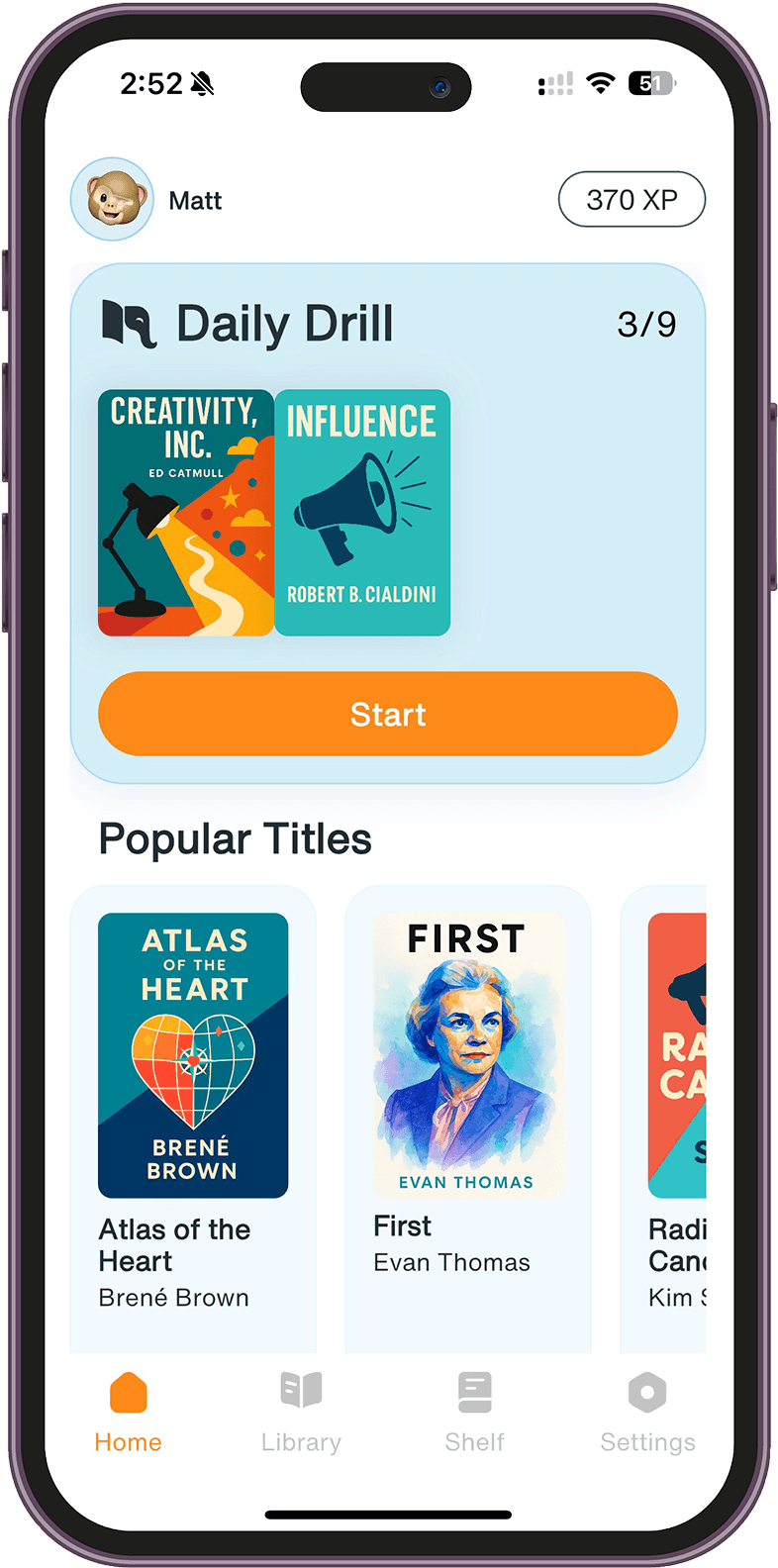
Loxie uses spaced repetition and active recall—the two most scientifically validated learning techniques—to help you retain concise writing principles permanently. Instead of reading once and forgetting, you practice for 2 minutes a day with questions that resurface concepts right before you'd naturally forget them.
The questions aren't trivia. They're designed to reinforce practical application: When should you split a compound sentence? What's wrong with 'advance planning'? How do you convert passive voice to active? Each time you successfully recall an answer, the interval before you see it again increases. Over time, these techniques move from fragile short-term memory into permanent long-term retention.
Loxie's free version includes the complete Writing Concisely topic, so you can start reinforcing these concepts immediately. Because knowing how to write concisely only matters if you remember it when you're actually writing.
Frequently Asked Questions
What does writing concisely mean?
Writing concisely means communicating your message using the fewest words necessary without losing meaning or nuance. It's not about dumbing down content but about disciplined clarity—ensuring every word earns its place by delivering value to the reader. Concise writing respects readers' time while maximizing comprehension and impact.
What is the one-idea-per-sentence principle?
The one-idea-per-sentence principle means each sentence should convey a single distinct thought. Human working memory can only hold 7±2 items at once, so mixing multiple ideas forces readers to mentally separate and reconnect concepts. Limiting sentences to one idea aligns with natural cognitive processing and improves comprehension.
What are common redundant phrases to eliminate?
Common redundant phrases include 'advance planning' (planning already implies advance), 'past history' (history is always past), 'end result' (result implies end), 'combine together,' 'free gift,' and 'unexpected surprise.' Removing these modifiers cuts 3-5% of words from typical documents without losing any meaning.
Why should you front-load important information?
Front-loading puts your main message in the first two sentences because readers decide whether to continue reading based on openings. Eye-tracking studies show readers spend 60% of attention on the first third of emails. Burying key points in paragraph three means they often go unread, causing delays or missed actions.
What is the difference between active and passive voice?
Active voice places the actor before the action ('The team submitted the report'), while passive voice puts the action first ('The report was submitted by the team'). Active voice clarifies responsibility, reduces word count by 20-30%, and improves reading speed and comprehension because readers don't need to reconstruct who did what.
How can Loxie help me write more concisely?
Loxie uses spaced repetition and active recall to help you retain concise writing techniques permanently. Instead of reading once and forgetting, you practice for 2 minutes a day with questions that resurface principles like eliminating redundancy, using active voice, and front-loading information right before you'd naturally forget them.
Stop forgetting what you learn.
Start learning for good with your 7-day FREE trial.