Active Recall: Why Testing Yourself Beats Re-Reading Every Time
The counterintuitive truth about how memory actually works.
Matthew Metzger

Former Fortune 200 VP of Learning

The Surprise
The Study Technique That Outperforms Everything Else
When students want to learn something, most default to the same approach: read it again. Highlight the important parts. Maybe read it a third time.
It feels productive. The information looks familiar. You recognize the concepts. Surely that means you're learning.
Except you're not. Or at least, not nearly as well as you could be.
Decades of research have consistently shown that actively retrieving information from memory - testing yourself rather than re-reading - produces dramatically better long-term retention. This phenomenon is called the testing effect, and it flips conventional study wisdom on its head.
The testing effect suggests that the act of retrieval itself strengthens memory. It's not just a way to assess what you know - it's a way to deepen what you know. Every time you successfully pull information from your memory, you make that information easier to access in the future.
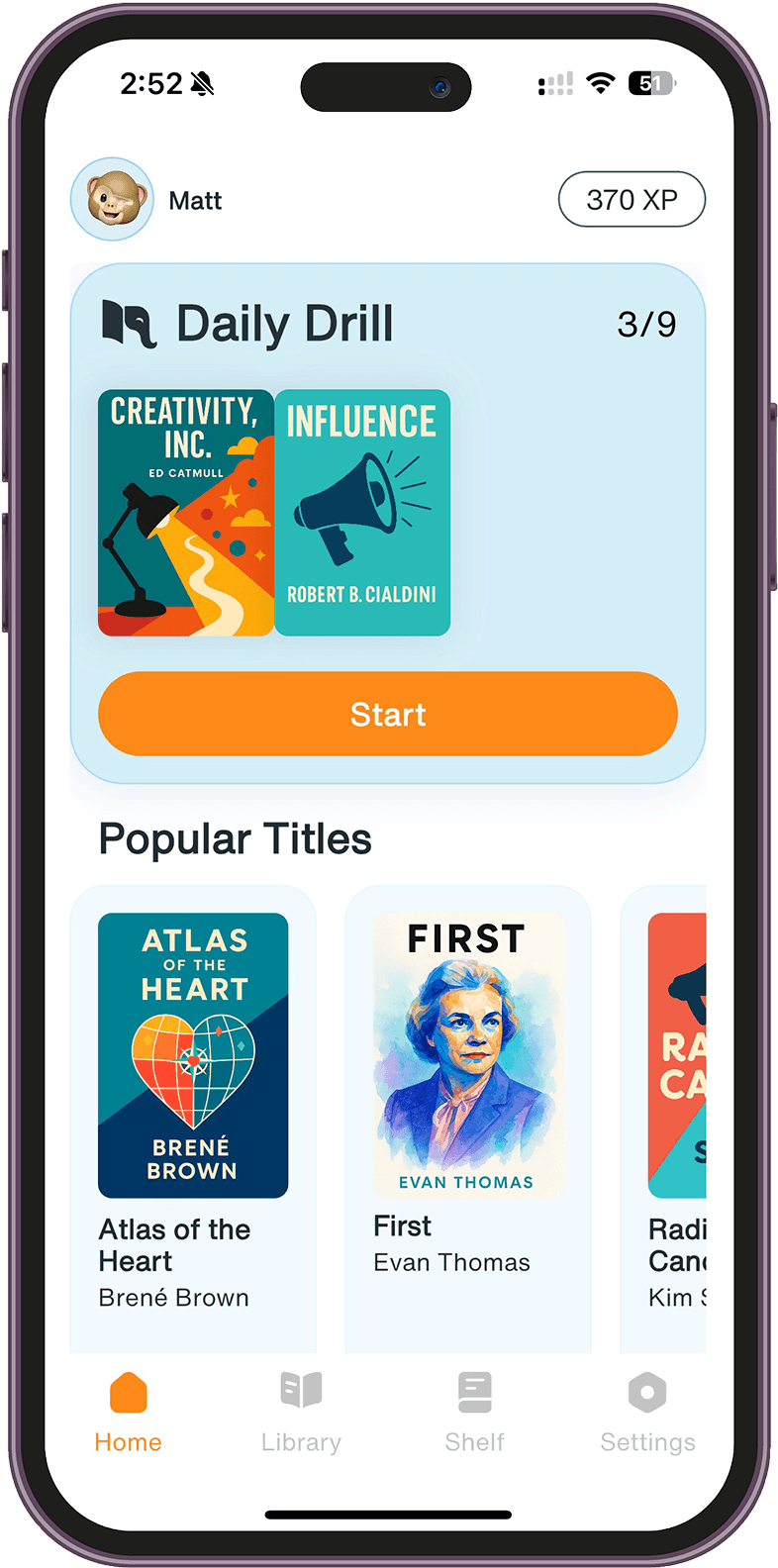
This is the core principle behind how Loxie works. Instead of passively reviewing content, you actively answer questions about it. That retrieval effort is what transforms fleeting exposure into lasting knowledge.
The Research
What Happened When Scientists Tested Testing
In 2006, psychologists Henry Roediger and Jeffrey Karpicke at Washington University conducted a landmark study that would reshape how we understand learning.
They had students study prose passages under different conditions. Some students studied the material four times in a row. Others studied it once and then took three practice tests on the content - without any feedback on their answers. Five minutes later, both groups performed about the same on a final test. But when tested again two days later and one week later, the results diverged dramatically.
Students who had repeatedly studied the material forgot 56% of what they originally recalled. Students who had tested themselves forgot only 13%.
Let that sink in. The students who spent their time re-reading - the strategy most people default to - lost more than half of what they learned. The students who practiced retrieving the information retained nearly all of it.
Perhaps most striking: the re-study group was more confident in their ability to remember the material. They felt like they knew it better, even though they actually retained far less. Familiarity is not the same as knowledge.
Loxie applies this research directly. Instead of having you re-read summaries or review notes, it asks you questions that force retrieval. That retrieval is the learning.
The Mechanism
Why Pulling Information Out Beats Putting It In
The testing effect seems backward. Shouldn't studying - putting information into your brain - be more valuable than testing - checking what's already there?
The research says no, and the reason comes down to how memory works.
When you re-read something, your brain engages in recognition. You see the information, it looks familiar, and you move on. The neural pathway gets a small boost, but not much - you're essentially confirming what's already there rather than strengthening it.
When you try to retrieve something, your brain has to reconstruct the information from scratch. It searches through memory, identifies relevant connections, and actively rebuilds the answer. This reconstruction process strengthens the neural pathway far more than passive recognition does. You're not just accessing the memory - you're reinforcing the entire route to get there.
Researchers describe this as "desirable difficulty." Retrieval is harder than re-reading, and that difficulty is precisely what makes it more effective. Easy studying produces weak memories. Effortful retrieval produces strong ones.
There's another benefit too: retrieval reveals gaps. When you re-read, everything looks familiar - including things you don't actually know. When you test yourself, you discover exactly where your understanding breaks down. Loxie's questions expose these gaps so you can focus your energy where it matters most.
The Evidence
A Finding That Keeps Getting Confirmed
The testing effect isn't a one-off finding. It's been replicated across hundreds of studies, with different populations, different materials, and different testing conditions.
A comprehensive review of the research found that retrieval practice enhances learning for educational texts, vocabulary, scientific concepts, mathematical procedures, and practical skills. It works for children and adults. It works in classrooms and laboratories. It works whether the final test is multiple choice, short answer, or essay format.
The benefits extend beyond simple recall. Studies have shown that retrieval practice improves the ability to apply knowledge to new situations - what researchers call transfer. Students who test themselves don't just remember facts better; they understand concepts more deeply and can use them more flexibly.
One particularly striking finding: retrieval practice works even when you get the answer wrong. The act of attempting to retrieve - of searching your memory and generating a response - provides learning benefits regardless of accuracy. Getting feedback afterward helps, but the retrieval attempt itself is valuable.
This is why Loxie includes questions at multiple difficulty levels. Level 1 questions test basic recall. Level 2 questions require deeper processing. Level 3 questions ask you to apply and connect concepts. Each level demands retrieval, and each retrieval strengthens your knowledge.
The Problem
Why Students Keep Choosing Inferior Methods
If testing yourself is so much more effective than re-reading, why do most people still default to re-reading?
Part of the answer is effort. Re-reading is easy. You sit down, you look at the page, you feel productive. Testing yourself is uncomfortable. You stare at a question, realize you don't know the answer, and confront the limits of your knowledge. Most people avoid that discomfort.
Part of the answer is illusion. Re-reading creates a powerful sense of familiarity that feels like learning. You recognize the material, so you assume you know it. Testing shatters that illusion - but most people never test themselves, so they never discover the gap between recognition and recall.
And part of the answer is habit. Students spend years in educational systems that emphasize reading, highlighting, and note-taking. Testing is something that happens to you, administered by teachers to generate grades. The idea that testing could be a learning strategy - something you do for yourself - simply doesn't occur to most people.
Research by Karpicke and colleagues found that when students are left to study on their own, very few use retrieval practice. They know it works when asked directly, but they don't choose it spontaneously. The strategy that produces the best results is also the strategy people are least likely to use on their own.
Loxie solves this by making retrieval the default. You don't have to remember to test yourself or overcome the resistance to doing it. You just open the app and answer questions. The effortful retrieval happens automatically.
The Application
Making Active Recall Work for You
The research on active recall points to a simple conclusion: if you want to remember something, practice retrieving it.
This doesn't mean you should stop reading or taking notes. Initial exposure matters - you can't retrieve what you never encoded in the first place. But it does mean that reading alone isn't enough. The real learning happens when you close the book, look away from your notes, and try to reconstruct what you just learned from memory.
The most effective approach combines active recall with spaced repetition. You retrieve information at strategic intervals, spacing out your practice to maximize retention. Each retrieval strengthens memory. Each spacing interval allows some forgetting, which makes the next retrieval more effortful and therefore more valuable.
This is exactly what Loxie does. You tell it what you want to remember - a book, a topic, a skill - and it generates questions that force active retrieval. It schedules those questions at optimal intervals. It tracks your performance and adapts to your progress. All you do is show up and answer.
The testing effect has been documented for over a century. The science is clear. The only question is whether you'll apply it.
With Loxie, applying it takes two minutes a day.