Spaced Repetition: The Memory Technique That Actually Works
Why cramming fails and strategic timing wins.
Matthew Metzger

Former Fortune 200 VP of Learning

The Principle
The Most Powerful Learning Technique You're Not Using
Here's a question: if you wanted to remember something for a year, would you rather study it for four hours straight or for one hour spread across four sessions over two weeks?
Most people intuitively choose the marathon session. It feels more thorough. More serious. More likely to stick.
They're wrong.
Decades of research have consistently shown that distributed practice - spreading your learning across multiple sessions separated by time - dramatically outperforms massed practice (cramming). This phenomenon is called the spacing effect, and it's one of the most reliable findings in all of cognitive science.
The spacing effect was first documented by Hermann Ebbinghaus in 1885, the same researcher who discovered the forgetting curve. He noticed that information reviewed at intervals was retained far longer than information reviewed repeatedly in a single session. Every major study since has confirmed his observation.
Spaced repetition is the practical application of the spacing effect. Instead of reviewing everything at random intervals, you review information on a strategic schedule - with gaps that expand as your memory strengthens. It's how Loxie ensures that what you learn today stays with you months and years from now.
The Evidence
What 271 Studies Tell Us About Timing
In 2006, researchers Cepeda, Pashler, Vul, Wixted, and Rohrer conducted a massive meta-analysis examining the spacing effect across hundreds of experiments. Their finding was striking: spaced practice outperformed massed practice in 259 out of 271 cases examined. That's a 96% success rate across diverse learning contexts, materials, and populations.
A follow-up study in 2008 by the same team tested over 1,350 people on fact retention with gaps ranging from zero to 105 days and final tests administered up to a year later. The results revealed something important about optimal timing: the best gap between study sessions depends on how long you want to remember the information.
For a one-week retention goal, the optimal gap between sessions was about 20-40% of that interval - roughly one to three days. For a one-year retention goal, the optimal gap dropped to about 5-10% of the interval. In other words, the longer you want to remember something, the more strategically you need to space your reviews.
This research confirms what effective learners discover through experience: timing isn't just important - it's everything. Loxie's algorithm is built on this principle, calculating optimal review intervals based on how well you know each piece of information and how long you want to retain it.
The Mechanism
Why Spacing Works Better Than Cramming
Cramming feels effective because it produces strong short-term performance. You study intensively the night before an exam and walk in feeling confident. But that confidence is an illusion. The information is accessible in the moment but hasn't been encoded for long-term retention.
Spacing works differently. When you encounter information after a delay, your brain has to work harder to retrieve it. That effort - the struggle to recall something that's starting to fade - is precisely what strengthens the memory. Easy retrieval doesn't build durable memories. Effortful retrieval does.
Researchers call this "desirable difficulty." A review that feels slightly challenging is actually more valuable than one that feels effortless. When you space your practice, each session requires more cognitive effort than if you'd reviewed immediately. That effort signals to your brain that this information matters and should be preserved.
There's also an encoding benefit. When you study something on Monday and again on Thursday, you're encoding it in two different mental contexts - different moods, environments, and states of mind. This contextual variation creates multiple retrieval pathways, making the information accessible from more angles.
Loxie creates desirable difficulty automatically. It waits until information is on the edge of being forgotten, then asks you to retrieve it. That productive struggle is what transforms short-term exposure into long-term knowledge.
The History
From Index Cards to Algorithms
People have been using spaced repetition systems long before anyone called them that.
In 1972, German journalist Sebastian Leitner published a book describing a systematic approach to flashcard review. His method - now called the Leitner system - used a series of boxes to track how well you knew each card. New cards started in box one and got reviewed daily. Cards you answered correctly moved to box two (reviewed every few days), then box three (weekly), and so on. Cards you missed moved back to box one.
The system was elegant but manual. You had to manage the boxes, sort the cards, and maintain the schedule yourself. Most people who tried it eventually abandoned it - not because it didn't work, but because the overhead was too high.
Digital technology changed everything. Software could track thousands of items, calculate optimal intervals, and adapt to individual performance automatically. Spaced repetition systems like SuperMemo (1987) and Anki (2006) made the technique accessible to anyone willing to build their own flashcard decks.
Loxie takes this evolution further. Instead of requiring you to create flashcards and manage a system, Loxie generates questions based on the topics you're learning and handles all the scheduling invisibly. You get the full benefit of spaced repetition without any of the administrative burden.
The Problem
Why Most People Don't Use Spaced Repetition
If spaced repetition is so effective - 96% success rate across hundreds of studies - why isn't everyone using it?
The answer is friction.
Traditional spaced repetition requires significant upfront investment. You need to identify what's worth remembering, create flashcards or review materials, organize them into some system, and then actually follow the schedule when life gets busy. Each step is a potential dropout point. Most people never get past the first one.
There's also a psychological barrier. Spaced repetition means accepting that you'll forget things. The whole system is built around the assumption that information fades and needs to be refreshed. For people who believe they should just "know" things after learning them once, this feels like an admission of failure.
And the benefits are invisible in the short term. Cramming produces immediate results you can feel. Spaced repetition produces long-term results you won't notice for weeks or months. In a world optimized for instant gratification, delayed payoffs are a hard sell.
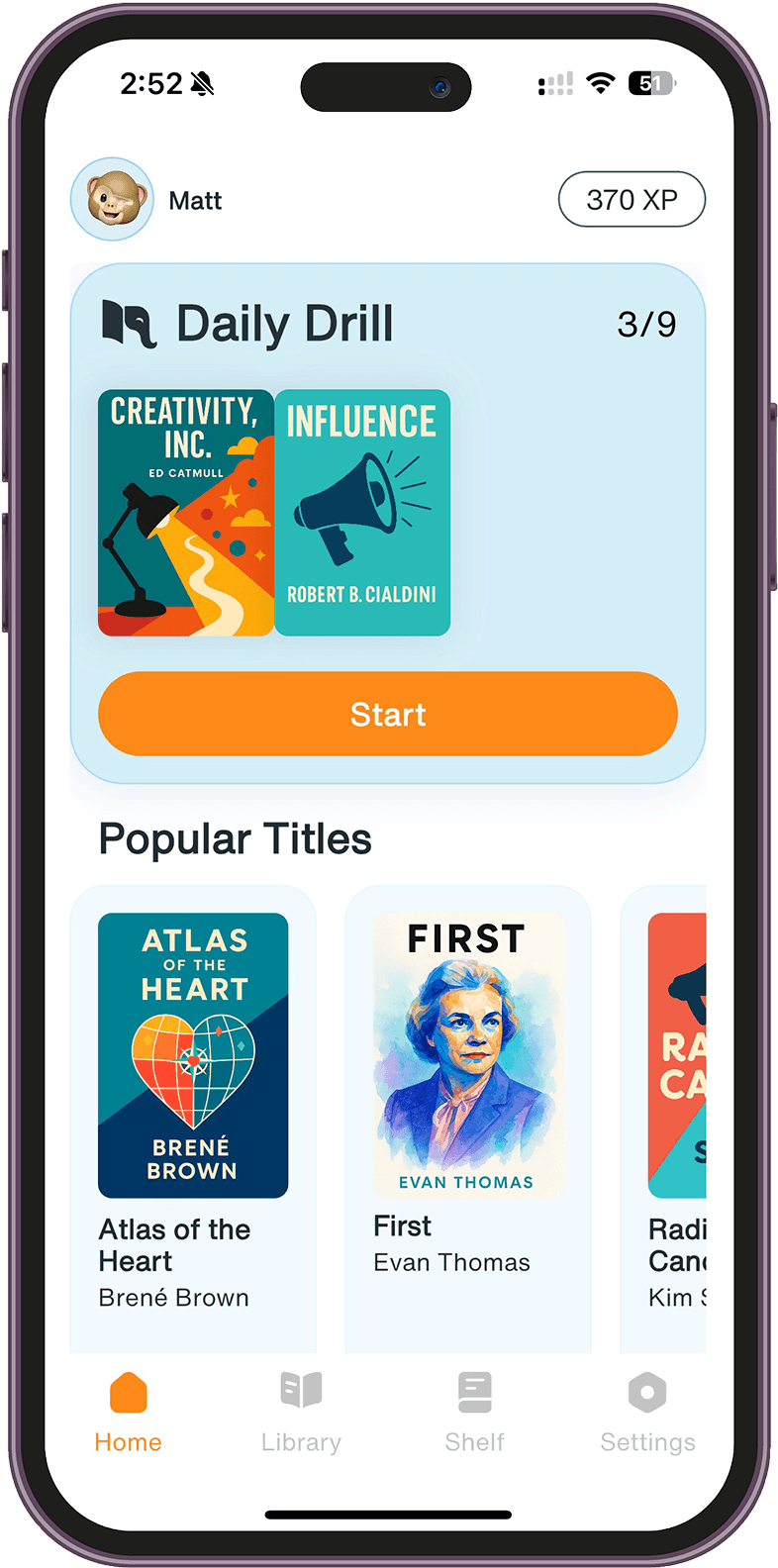
Loxie removes these barriers. The questions are generated for you. The scheduling happens automatically. And the daily drill takes just a few minutes - short enough to fit into any routine, long enough to keep the forgetting curve at bay.
The Application
Making Spaced Repetition Work for You
The research is clear: spaced repetition works. The question is whether you'll actually use it.
The key is reducing friction to near zero. If practicing takes significant time or mental energy, it won't become a habit. If it requires you to manage systems, create content, or make scheduling decisions, you'll eventually stop. The most effective learning system is the one you'll actually use consistently.
This is why Loxie focuses on simplicity. You choose the topics you care about - books you've read, subjects you're studying, skills you're developing. Loxie handles everything else: generating relevant questions, scheduling them at optimal intervals, and tracking your progress over time.
The daily commitment is minimal. A few minutes answering questions about things you've already decided are worth knowing. But those few minutes, applied consistently, produce compounding returns. Each review strengthens memory. Each strengthened memory decays more slowly. Over weeks and months, information that would have vanished becomes permanently accessible.
Spaced repetition isn't a hack or a shortcut. It's how memory actually works, applied systematically. The spacing effect has been documented for over a century. The only question is whether you'll take advantage of it.
Loxie makes that easy.