Best Active Recall Apps in 2026
The most effective learning technique is also the least used. These apps change that.
Matthew Metzger

Former Fortune 200 VP of Learning
The Science
Why Active Recall Beats Everything Else
The best active recall apps include Loxie for books and topics, Anki for custom flashcards, Quizlet for academic subjects, Brainscape for certifications, and RemNote for note-takers.
Active recall - testing yourself instead of re-reading - is proven to boost retention by over 50% compared to passive review. But most apps require you to build your own questions (which is why Loxie, with pre-built questions across hundreds of topics, is our top pick).
Top Pick
Loxie – Best Active Recall App for Books and Topics
What it is: Loxie is a learning and retention app that uses active recall and spaced repetition to help you remember books and topics. It also offers free learning content: 8-10 minute video overviews, 30-45 minute podcast deep dives, and written summaries.
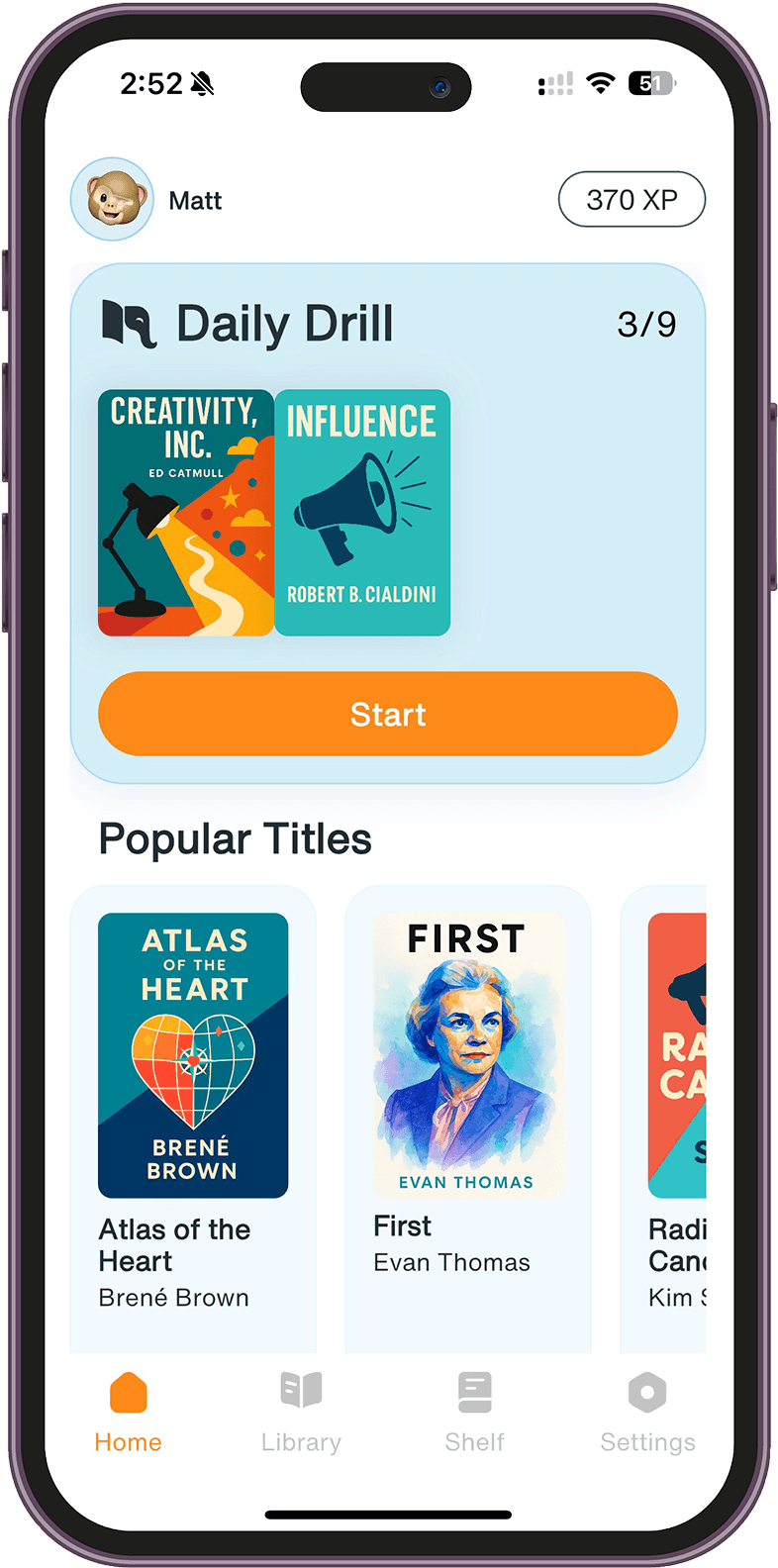
How it works: Add books or topics to your shelf, and Loxie serves you a Daily Drill – questions that force you to retrieve information rather than passively review it. Questions progress across difficulty levels, from basic recall to application and synthesis.
What makes it different: Most active recall apps require you to write your own questions. Loxie provides them. You get research-backed retrieval practice without the overhead of building a question bank.
Limitations: The catalogue covers hundreds of books and topics rather than thousands. Check the current catalogue to see what's available. For subjects outside the catalogue, you'd need a DIY tool.
Best for: Readers and lifelong learners who want active recall without the setup. People learning from nonfiction books, professional development, or personal interests.
Pricing: Learning content is free. Retention drills are free for 7 days, then Pro ($59.99/year or $7.99/month)* for unlimited drills and advanced features.
Try it: loxie.app
For DIY Questions
Anki – Best Active Recall App for Power Users
What it is: Anki is a free, open-source flashcard app that combines active recall with spaced repetition. You create question-and-answer cards, then test yourself on them over time.
How it works: Build flashcards with a question on one side and answer on the other. Anki shows you the question, you attempt to recall the answer, then rate how well you did. The app schedules future reviews accordingly.
What makes it different: Complete control over your questions and content. Highly customizable algorithm. Free on most platforms. Massive community sharing decks.
Limitations: You write all your own questions – which is time-consuming and requires knowing what's worth asking. The interface is confusing for beginners. Many people abandon Anki because the setup and maintenance overhead is too high.
Best for: Power users who enjoy building systems. Medical students, language learners, and anyone willing to invest significant time in creating and maintaining flashcards.
Pricing: Free on desktop, Android, and AnkiWeb. iOS app is ~$25 (one-time).*
For Students
Quizlet – Best Active Recall for Academic Subjects
What it is: Quizlet is a flashcard platform with millions of user-generated study sets. The Learn and Test modes apply active recall principles.
How it works: Find existing flashcard sets or create your own. Use Learn mode to practice retrieval, or Test mode to generate practice quizzes. The app tracks which cards you struggle with.
What makes it different: Huge library of pre-made content for academic subjects. Modern, approachable interface. Game-like modes make practice feel less tedious.
Limitations: Content quality varies since it's user-generated. The app skews heavily toward students and academic subjects – less useful for professional development or book-based learning. Some features require a paid subscription.
Best for: Students preparing for exams. Anyone who wants access to pre-made flashcard sets for classes.
Pricing: Free with ads and limits. Quizlet Plus is $7.99/month or $35.99/year.*
For Certifications
Brainscape – Best Active Recall for Professional Exams
What it is: Brainscape offers flashcard-based active recall with a library of certified, expert-created content for professional certifications and academic subjects.
How it works: Study flashcards by attempting to recall the answer, then rate your confidence (1-5). Cards you rate lower appear more frequently. The confidence-based system ensures you spend more time on material you don't know.
What makes it different: Certified content created by actual experts – not random users. Polished interface that's easier to navigate than Anki.
Limitations: For topics outside their certified library, you're creating your own flashcards. The best content requires a Pro subscription.
Best for: Professionals studying for certifications (bar exam, medical boards, PMP). Learners who want expert-created questions in specific fields.
Pricing: Free tier available. Pro from ~$7.99/month.*
For Note-Takers
RemNote – Best Active Recall Built Into Note-Taking
What it is: RemNote is a note-taking app with built-in flashcard and spaced repetition features. As you take notes, you can mark items as flashcards without leaving the app.
How it works: Take notes normally, then use special formatting to turn key points into flashcards. RemNote schedules reviews automatically. Your notes and flashcards live in the same system.
What makes it different: Seamless integration between notes and active recall. No need to export notes to a separate flashcard app. Good for people who already take detailed notes.
Limitations: You still create your own questions – the app just makes the workflow smoother. There's a learning curve to the formatting system. Better for structured note-takers than casual readers.
Best for: People who take detailed notes and want flashcards integrated into their workflow. Those who find exporting to Anki too cumbersome.
Pricing: Free tier available. Pro ~$8/month.*
The Verdict
Which Active Recall App Should You Use?
It depends on what you're learning and how much work you want to do:
If you want active recall without writing questions: Loxie. Pre-built questions for books and topics. Add something to your shelf and start practicing immediately.
If you want full control and don't mind the work: Anki. Build your own questions exactly how you want them.
If you're a student with academic subjects: Quizlet. Massive library of pre-made flashcard sets for classes.
If you're studying for professional certifications: Brainscape. Expert-created questions for specific exams.
If you take detailed notes already: RemNote. Convert your notes to flashcards without switching apps.
The science is clear: active recall works better than passive review. The question is whether you'll actually use it. Apps that require you to write your own questions work great for motivated power users. For everyone else, apps with pre-built content remove the friction that causes most people to quit.
FAQ
Frequently Asked Questions
What is active recall? A learning technique where you test yourself on material rather than passively reviewing it. Instead of re-reading a chapter, you close the book and try to remember the key points. This retrieval effort strengthens memory far more than recognition.
Is active recall the same as flashcards? Flashcards are one way to practice active recall, but not the only way. Any method that forces you to retrieve information – practice tests, self-quizzing, teaching someone else – counts as active recall. The key is retrieval, not the format.
Why does active recall feel harder than re-reading? Because it is harder. Retrieving information requires more mental effort than recognizing it. But that effort is exactly what strengthens memory. The discomfort is a feature, not a bug.
Do I have to make my own questions? Not anymore. Apps like Loxie and Brainscape provide pre-built questions. Quizlet has millions of user-generated sets. Anki and RemNote require DIY but offer more control.
How is active recall different from spaced repetition? Active recall is the technique (testing yourself). Spaced repetition is the timing (reviewing at optimal intervals). The best apps combine both – you test yourself AND the app schedules those tests at the right times.
Can I use active recall for books? Yes. Loxie applies active recall specifically to book content – no question writing required. Alternatively, you can create your own questions in Anki after reading, though most people find this too time-intensive to sustain.
How much time does active recall practice take? Typically 5-15 minutes per day. Short, consistent sessions beat occasional long ones. The key is making retrieval practice a daily habit.
*App prices change frequently and may vary by region or promotional offers. We've included approximate pricing to help you compare, but always check the official app or website for current rates before subscribing.