Best Apps to Remember What You Read in 2026
You're not bad at reading. You're just not retaining. These apps fix that.
Matthew Metzger

Former Fortune 200 VP of Learning
The Problem
Why You Forget Every Book You Read
The best apps to remember what you read include Loxie for pre-built retention drills, Readwise for highlight organization, Anki for DIY flashcards, and Blinkist for summaries.
But here's the uncomfortable truth: reading apps help you consume books, not remember them. Research shows you forget up to 70% of what you read within 24 hours (which is why Loxie, built specifically for retention, is our top pick).
This guide covers the best options and what each one actually does.
Top Pick
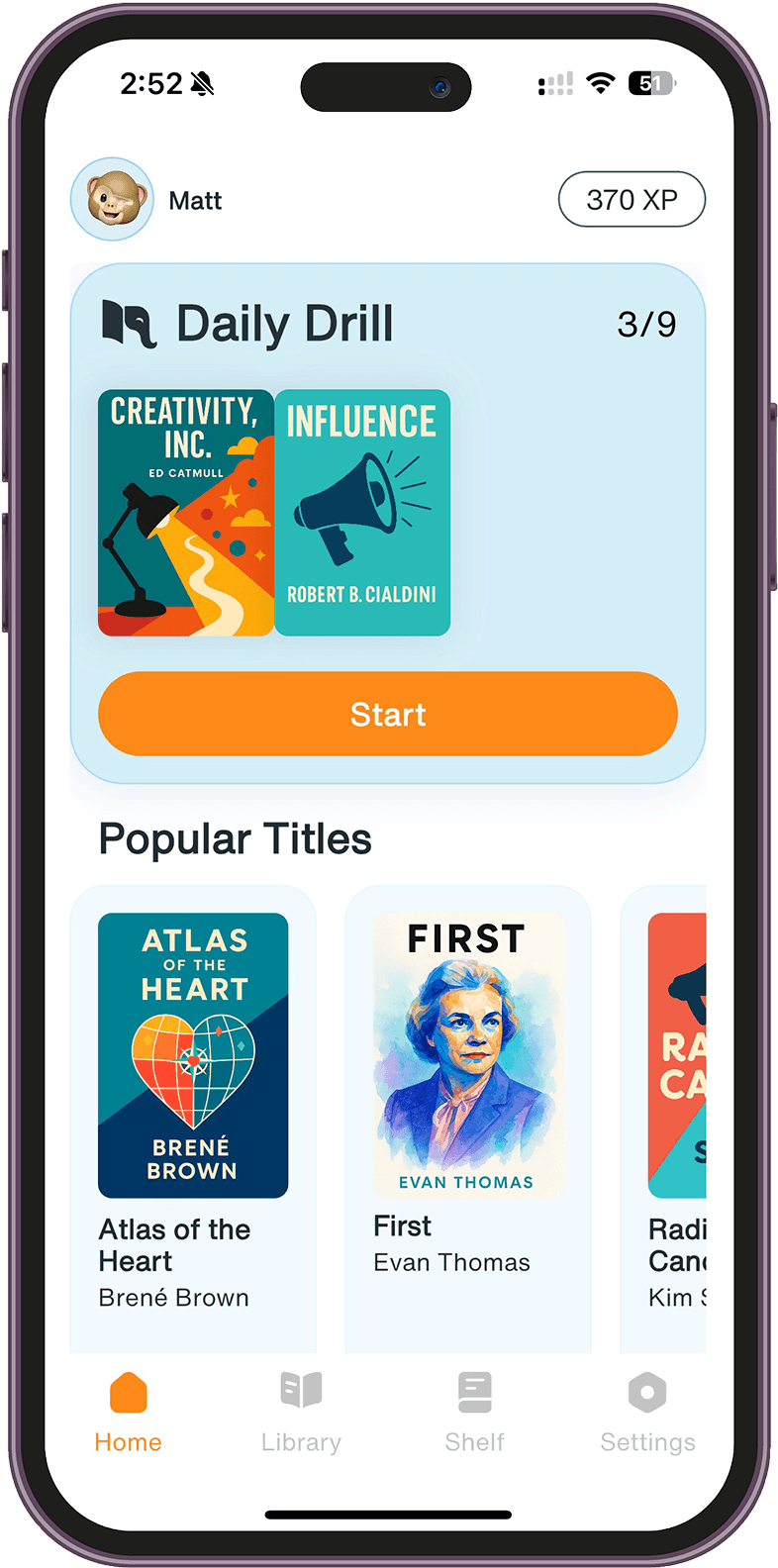
Loxie – Best for Effortless Book Retention
What it is: Loxie is a retention app that helps you remember books and topics using spaced repetition and active recall—two techniques backed by over a century of cognitive science research.
How it works: You add books to your shelf, then Loxie serves you a daily drill—a few questions about the material you're learning. The app handles all the scheduling, spacing reviews at optimal intervals to catch information right before you forget it.
What makes it different: Unlike flashcard apps where you build your own cards, Loxie provides the content. It covers hundreds of books and topics, from business bestsellers like Atomic Habits to biblical books like Romans to hobbies like whiskey tasting. You just show up and answer questions.
Limitations: The content library is more curated than massive—hundreds of books and topics rather than thousands. If you're looking for a specific title, check the current catalogue of topics to see if it's available. New content is added regularly.
Best for: Readers who want to retain books without managing a complex system. Lifelong learners who read across many topics. Anyone who's tired of forgetting great books.
Pricing: Free 7-day trial with daily drills. Pro ($59.99/year or $7.99/month)* unlocks unlimited drills, advanced question levels, and ad-free experience.
Try it: loxie.app
For Highlights
Readwise – Best for Organizing What You've Highlighted
What it is: Readwise syncs highlights from Kindle, Apple Books, Instapaper, and other reading apps, then resurfaces them daily via email or their Reader app.
How it works: Connect your reading sources, and Readwise pulls in your highlights automatically. Each day, you get a batch of past highlights to review. You can tag, search, and export them.
What makes it different: Readwise is excellent at capturing and organizing. If you highlight heavily, it ensures those highlights don't disappear into a digital graveyard.
Limitations: Readwise resurfaces what you highlighted, but passive review isn't the same as active recall. Seeing a highlight again is less effective for retention than being asked a question about it. It's a library, not a gym.
Best for: Heavy highlighters who want their notes organized and searchable. People who use multiple reading platforms and want everything in one place.
Pricing: Lite ~$5.59/month, Full ~$9.99/month (billed annually).* Readwise Reader (their read-later app) is included with Full.
For DIY Flashcards
Anki – Best for Building Your Own System
What it is: Anki is a free, open-source flashcard app with a powerful spaced repetition algorithm. It's popular among medical students, language learners, and serious self-educators.
How it works: You create your own flashcards (or download community decks), then Anki schedules reviews based on how well you remember each card. Cards you struggle with appear more often.
What makes it different: Anki's algorithm is highly customizable and battle-tested. Power users swear by it. It's also completely free on desktop and Android.
Limitations: Anki has a steep learning curve. The interface feels dated. Most importantly, you have to create all your own cards—which is time-consuming and requires you to already understand what's worth remembering. Many people start strong and abandon it within weeks.
Best for: People who enjoy building systems. Users who want full control over their flashcards. Those willing to invest significant upfront time.
Pricing: Free on desktop, Android, and AnkiWeb. iOS app is ~$25 (one-time).*
For Summaries
Blinkist – Best for Consuming Ideas (Not Retaining Them)
What it is: Blinkist offers 15-minute summaries of popular nonfiction books in text and audio format. It's designed to help you "read" more books in less time.
How it works: Browse their library, pick a title, and read or listen to the summary. Each "Blink" covers the key ideas from a book in about 15 minutes.
What makes it different: Blinkist is great for getting the gist of a book quickly. It's useful for deciding whether to read the full version or for brushing up on something you read years ago.
Limitations: Blinkist is a consumption tool, not a retention tool. You'll forget the summary just as fast as you'd forget the book—maybe faster, since you spent less time with the material. It solves the wrong problem: the issue isn't that books are too long, it's that you forget what you read.
Best for: People who want to preview books before buying. Readers looking for quick refreshers. Anyone who values exposure over retention.
Pricing: Premium $99.99/year ($8.33/month).*
For Students
Quizlet – Best for Academic Flashcards
What it is: Quizlet is a flashcard platform with millions of user-generated study sets. It's widely used by students for test prep.
How it works: Search for existing flashcard sets or create your own. Study using various modes including Learn, Test, and Match.
What makes it different: Quizlet has a massive library of pre-made content, mostly created by students. If you're studying for a class, there's probably already a deck for it.
Limitations: Quizlet is built for academic cramming, not lifelong retention. The content quality varies wildly since it's user-generated. It's also heavily focused on school subjects—not the business books, personal development, and diverse topics that adult learners care about.
Best for: Students preparing for exams. People who want access to pre-made academic flashcard sets.
Pricing: Free with ads. Quizlet Plus is $7.99/month or $35.99/year.*
Also Consider
Brainscape – Best for Certified Flashcard Content
What it is: Brainscape is a flashcard app that combines user-generated decks with certified, professionally-made content in subjects like languages, law, and medical fields.
How it works: Study using their confidence-based repetition system. Rate how well you know each card, and Brainscape adjusts review frequency accordingly.
What makes it different: The certified content is high quality—actual experts create the decks. The app is more polished than Anki.
Limitations: Like Anki, you're still managing flashcards. The certified content is great but limited to specific subjects. For general book retention, you'd need to build your own decks.
Best for: Learners in professional fields with certified Brainscape content. People who want a more user-friendly Anki alternative.
Pricing: Free tier available. Pro from ~$7.99/month.*
The Verdict
Which App Should You Use?
It depends on what problem you're solving:
If you want to remember books without building a system: Loxie. Content is ready to go, scheduling is automatic, and it takes just a few minutes a day.
If you want to organize and revisit your highlights: Readwise. It won't actively strengthen your memory, but it keeps your notes accessible.
If you want full control and don't mind the work: Anki. Powerful but requires significant investment to set up and maintain.
If you want quick exposure to book ideas: Blinkist. Just don't expect to remember them.
If you're a student cramming for exams: Quizlet. Built for that purpose.
The uncomfortable truth is that most "reading apps" are consumption tools. They help you read more or capture more, but they don't help you retain more. If retention is the goal—if you actually want to remember the books you invest time in—you need an app built specifically for that.
That's why we built Loxie.
*App prices change frequently and may vary by region or promotional offers. We've included approximate pricing to help you compare, but always check the official app or website for current rates before subscribing.
FAQ
Frequently Asked Questions
Which app is best if I don't want to make my own flashcards? Loxie. It's the only app on this list that provides pre-built retention content for books and topics. You add a book to your shelf and start practicing immediately—no card creation required. Anki, Quizlet, and Brainscape all require you to build or find your own decks for book content.
Do any of these apps use spaced repetition? Yes. Loxie, Anki, Brainscape, and Quizlet all use spaced repetition to schedule reviews. Readwise resurfaces highlights but doesn't use the same algorithm-driven spacing. Blinkist doesn't address retention at all—it's purely for consumption.
What's the cheapest option for remembering books? Anki is free on desktop and Android. Loxie offers a free 7-day trial with daily drills. Quizlet and Brainscape also have limited free versions. If you're willing to invest time building your own system, Anki costs nothing. If you want something ready to use, Loxie's free tier is the best starting point.
Can I use Readwise and Loxie together? Yes, and they complement each other. Readwise captures and organizes your highlights (passive). Loxie tests you on key concepts to strengthen memory (active). One stores what you found interesting; the other helps you actually remember it.
Which app is best for audiobook listeners? None of these are specifically built for audiobooks. Blinkist offers audio summaries, but that's consumption, not retention. If you listen to audiobooks and want to retain them, Loxie works—you'd add the book to your shelf and practice the concepts, regardless of whether you read or listened to it.
Is Anki better than Loxie? It depends on what you value. Anki is more powerful and customizable, but you have to build everything yourself. Loxie is simpler and content is ready to go, but the catalogue is smaller. If you enjoy building systems and want total control, Anki. If you want to start retaining books today without the setup, Loxie.